
latest
Nigeria’s Oil Production Sees Marginal Increase in August Despite Contradicting Government Reports

Nigeria’s Oil Production Sees Marginal Increase in August Despite Contradicting Government Reports....KINDLY READ THE FULL STORY HERE▶
Nigeria’s crude oil production experienced a slight increase from 1.307 million barrels per day (mbpd) in July to 1.352 mbpd in August, according to the latest data from the Organisation of the Petroleum Exporting Countries (OPEC). This update was included in OPEC’s September Monthly Oil Market Report, revealing a rise of 45,000 barrels per day, based on direct communication with the Nigerian government.
However, this figure contrasts with claims by the Nigerian Federal Government, which stated that the country’s daily crude production was approaching 1.6 mbpd.
During a national broadcast on August 4, President Bola Tinubu asserted that Nigeria’s oil production had surged to 1.61 mbpd in July, crediting the increase to reforms introduced in May 2024 aimed at addressing gaps in the Petroleum Industry Act (PIA).
“Our once-declining oil and gas industry is experiencing a resurgence on the back of the reforms I announced in May 2024 to address the gaps in the Petroleum Industry Act. Last month, we increased our oil production to 1.61 million barrels per day, and our gas assets are receiving the attention they deserve,” Tinubu stated.
Gbenga Komolafe, Chief Executive of the Nigerian Upstream Petroleum Regulatory Commission (NUPRC), echoed similar sentiments during a public hearing on July 26, where he announced that oil production had reached 1.61 mbpd as of July 23.
Conflicting Production Figures Raise Questions
Despite these official claims, OPEC’s data paints a different picture. The organization’s report indicated that Nigeria’s output for July was only 1.307 mbpd, significantly lower than the 1.61 mbpd figure touted by both President Tinubu and the NUPRC. This discrepancy raises questions about the accuracy of the government’s reporting on the nation’s oil output.
The Federal Government had also claimed earlier in May that oil production was nearing 1.7 mbpd. However, OPEC data showed that production during that period dipped to 1.25 mbpd, a decrease of 30,000 barrels per day from April’s 1.28 mbpd.
Nigeria’s Oil Production History: A Mixed Performance
Nigeria has faced ongoing challenges with oil production, frequently experiencing fluctuations. In April, OPEC reported that daily production had marginally improved to 1.28 mbpd, up from 1.23 mbpd in March. However, this growth was overshadowed by earlier losses. Production had dropped from 1.32 mbpd in February to 1.23 mbpd in March, and from 1.427 mbpd in January to 1.322 mbpd.


latest
“The Truth Finally Out: How Peter Obi Shocked Critics By Leaving ₦86.6 Billion Behind In Anambra!”


Oseloka Obaze, a former Secretary to the Anambra State Government, has stated that former governor Peter Obi left ₦86.6 billion in the state treasury when he handed over power in 2014. Obaze, who served under Obi from 2006 to 2014, made this revelation in a post on X amid ongoing controversies regarding the financial records inherited by successive administrations.....KINDLY READ THE FULL STORY HERE▶
Obaze noted that he was personally present on March 17, 2014, when Obi officially handed over financial documents and the Handover Report to his successor, Willie Obiano. According to him, Obiano received and signed an acknowledgment copy of the letter, which included certified bank statements detailing the state’s assets and liabilities.
Past Debates and Public Corroboration
Recalling the 2017 Anambra governorship debate organized by Channels Television, Obaze mentioned that he challenged Obiano—a certified accountant and auditor—on national television for later expressing reservations about the funds after formally signing off on the handover documents. Following this, Obiano publicly acknowledged that certain funds were left behind, though he questioned the rationale of saving money instead of executing projects.
Obaze also referenced remarks from former Taraba State Governor Darius Ishaku, noting that Obiano once told the Nigerian Press Corps that Obi left substantial funds used to finance the construction of the Anambra Airport at Umueri. Additionally, he cited comments from Abia State Governor Alex Otti, a former banker, as further public validation of the financial legacy.
Expressing confusion over why the records remain a subject of dispute under the current administration, Obaze concluded: “If Governor Obiano… would eventually acknowledge, implicitly and explicit, that Governor Peter Obi indeed left the stipulated funds; a fact that was also publicly corroborated by Governor Alex Otti… what then, one may ask, is the beef and grouse of the incumbent Anambra State Government?”
entertainment
“The Internet Never Forgets: How An 11-Year-Old Tweet Cost Blaqbonez A Major Young Jonn Feature”

Music producer-turned-singer Young Jonn turned down a collaboration offer from rapper Blaqbonez after unearthing a resurfaced 2015 post where the rapper stated a preference for DJ Coublon over him.....KINDLY READ THE FULL STORY HERE▶
The exchange began when Young Jonn posted on social media: “I need like 5 bad friends way we go dey move in bulk!”
Blaqbonez quickly expressed interest in linking up, replying, “Oya, make we dey together, sing as one.”
Instead of accepting, Young Jonn posted a screenshot of the old tweet showing Blaqbonez’s historical preference and clapped back: “Go sing as one with Coublon.”
In his defense, Blaqbonez denied writing the post himself, claiming it was the work of his social media handler back in 2015.
Why Peter Okoye Changed His Birthday Away From Twin Brother Paul
In other entertainment news, Nigerian singer Peter Okoye has explained his decision to shift his birthday celebration from November 18 to November 30.
Speaking on the Capital XTRA Podcast, Peter revealed that his shared birthday with his twin brother, Paul, had become one of the worst days of his life over the past 13 years due to toxic family dynamics and tension.
He alleged that visitors would frequently go to Paul’s house to gossip about him before visiting him, making the shared occasion deeply uncomfortable. “I wish I could change it on my documents and passport,” Peter stated.
This development highlights the ongoing strain between the twin brothers, who initially split in 2017, briefly reunited in 2021, and parted ways again in 2024.
latest
“World Cup Panic: NFF Fires Back At Reports Claiming Falconets Refused To Train Over Unpaid Bonuses!”
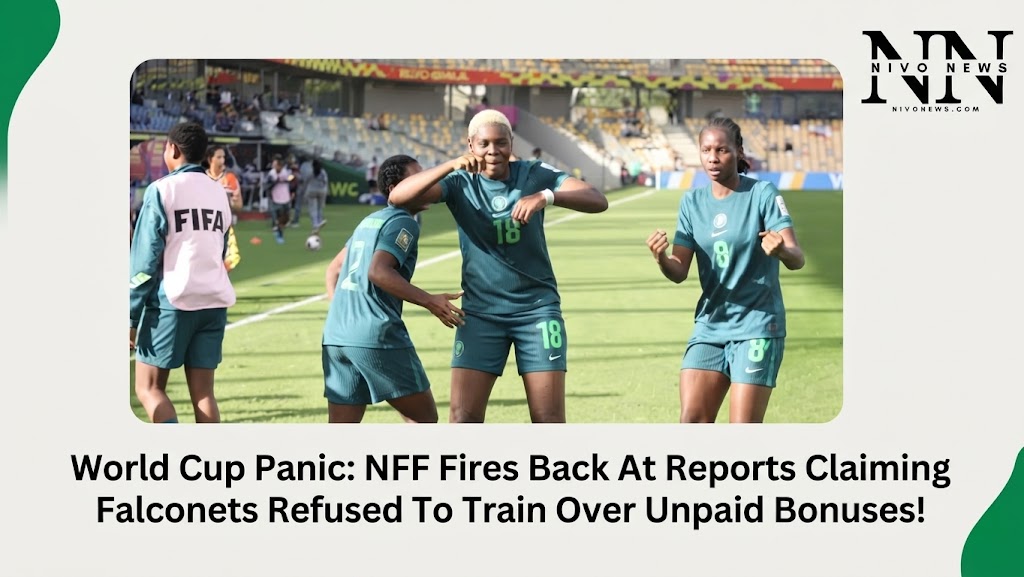
The Nigeria Football Federation (NFF) has strongly refuted claims that the Falconets planned to boycott training ahead of their 2026 FIFA U-20 Women’s World Cup quarter-final match against Colombia. While rumors suggested players were considering a training strike, the NFF dismissed the reports as entirely false and affirmed the team’s full focus.....KINDLY READ THE FULL STORY HERE▶
-
“Reports in a section of the media that the Falconets are planning to boycott training are an absolute falsehood,” the NFF stated.
-
“The girls are now heading to training for their last session before tomorrow’s match against Colombia.”
The Falconets advanced to the quarter-finals following a dominant 3-0 victory over England in the Round of 16. They are set to face Colombia at Stadion Miejski ŁKS in Łódź, with a semi-final spot on the line.
Squad Brilliance and Super Falcons Prospects
Reflecting on the tournament, head coach Moses Aduku expressed confidence that several players possess the talent to eventually transition into the senior national team, the Super Falcons.
Key performances have propelled Nigeria’s run:
-
Captain Christianah Uzoma delivered a crucial performance against England, saving a 33rd-minute penalty by Rachel Maltby to secure the team’s place in the last eight.
-
Winner Onajite David and Ramotalahi Kareem have spearheaded the attack, netting three goals each.
-
Janet Akekoromowei, Tosin Rafiu, and Rebecca Adegbemile have each contributed two goals to the campaign.
Emphasizing the importance of the tournament for player development, Aduku told FIFA, “I think the girls are doing well. We need to do more. There is going to be a transition to the senior national team from this junior side. So they really need to apply themselves.”
-

 latest1 year ago
“Social Media Erupts As Jim Iyke Declares Rita Dominic Nollywood’s Most Beautiful”
-
 latest3 years ago
Edo Political Showdown: Oshiomhole Appears At Presidential Villa As Tinubu Hands APC Gubernatorial Flag To Okpebholo (Photos & Video)
-
 entertainment2 years ago
Love Knows No Age American Woman Defends Marriage To Young Nigerian Man “I’m Not 70”
-
 latest3 years ago
Olumide Akpata Strikes Again: Drops Killer Track, Sends Edo State Into Frenzy!(Video)
-
 Politics3 years ago
Nigerians React As Pastor Adeboye Foresees Passing Away On A Sunday After Enjoying A Satisfying Meal Of Pounded Yam
-
 latest2 years ago
FG Identifies 31 States At Risk Of Heavy Flooding In 2024: See Full List
-
 Politics3 years ago
BREAKING: Inspector-General Of Police Summons Top Police Commanders For Crucial-Security Challenges
-
 latest3 years ago
5 NYSC Corpers Perish In Fatal Road Accident Returning From Camp