
Latest News
Separate Macaulay from Criminals, Bode George Tells Tinubu

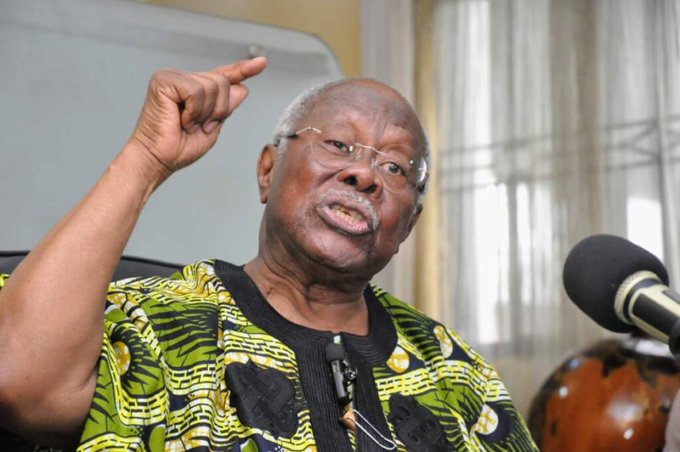
Chief Bode George, a chieftain of the Peoples Democratic Party (PDP) and descendant of Nigerian nationalist Herbert Macaulay, has urged President Bola Tinubu to separate the name of the late freedom fighter from a list of pardoned criminals recently announced by the Federal Government.....KINDLY READ THE FULL STORY HERE▶
Speaking at a press conference in Lagos on Thursday, George said the family of Herbert Macaulay appreciated the posthumous state pardon granted to the nationalist but found it inappropriate that his name was included alongside those convicted of serious crimes such as corruption, murder, and drug trafficking.
“It is unfair to lump Herbert Macaulay with those who have committed criminal offenses,” George said. “He should be isolated and honoured separately for his selfless contributions to Nigeria’s independence and nationhood.”
President Tinubu, on October 9, approved a presidential pardon for 175 people, including both living and deceased Nigerians. Among those granted clemency was Herbert Macaulay, widely regarded as one of the country’s founding fathers and the pioneer of Nigerian nationalism.
George described the gesture as “commendable” but said the symbolic grouping undermined Macaulay’s legacy. He called on the president to issue a distinct national recognition that reflects the late nationalist’s unique historical importance.
“Herbert Macaulay was never a criminal,” George added. “He stood against colonial injustice and worked tirelessly for the unity of this country. His name deserves to stand alone as a mark of respect.”
He also appealed to the Federal Government to rebuild Macaulay’s former home on Lagos Island, which was demolished during the colonial era to make way for the General Post Office. According to him, restoring the building as a national monument would serve as a fitting tribute to the man often called the “Father of Nigerian Nationalism.”
Born in 1864, Herbert Samuel Heelas Macaulay was an engineer, surveyor, journalist, and political leader who led early resistance against British colonial rule in Nigeria. He co-founded the Nigerian National Democratic Party (NNDP), the first political party in the country, and played a major role in promoting the rights of native Lagosians. He died in 1946 at the age of 82.
George said that while the pardon recognized Macaulay’s unjust colonial conviction, grouping him with offenders who were found guilty of serious crimes diminished the historical value of the act. “The intent was noble, but the execution fell short,” he said. “We ask the president to correct this oversight and honour him as a national hero, not just as a name on a list.”
The elder statesman noted that the Macaulay family would soon make a formal appeal to the Federal Government, proposing that the late nationalist be celebrated with a national monument, an annual remembrance day, or inclusion in civic education programs for schools.
He further urged the Tinubu administration to use national recognitions as opportunities to educate younger generations about the sacrifices of Nigeria’s founding fathers. “Our youth should know who Herbert Macaulay was and what he stood for,” George said. “Honouring him separately will remind Nigerians of our roots and the price of freedom.”
Political observers say the plea from George could renew discussions about how posthumous recognitions are managed in Nigeria. Some argue that combining nationalists and convicted criminals in the same presidential pardon announcement risks blurring the moral and historical distinctions between them.
The Presidency has not yet responded to George’s comments. However, officials familiar with the process said the government may consider additional ways to honour historical figures as part of ongoing national heritage projects.
For now, the Macaulay family and supporters are waiting to see if the call for a distinct honour will lead to concrete government action.
Herbert Macaulay’s legacy, rooted in courage, resistance, and patriotism, continues to inspire many Nigerians nearly eight decades after his death.



One of the prospective members of the National Youth Service Corps (NYSC) rescued from kidnappers in Imo State has recounted the horrifying conditions they endured in captivity, revealing that their abductors beat them and forced them to survive on dry garri and dirty water in a forest.....KINDLY READ THE FULL STORY HERE▶
Speaking in an interview with the BBC, the victim disclosed that the kidnappers monitored conversations between captives and their families, assaulting them whenever they were displeased with anything said during the calls.
She was among 20 prospective corps members and another passenger abducted on October 1, 2026, while travelling from Ibadan, Oyo State, to orientation camps in Abia and Akwa Ibom states.
According to her account, the kidnappers allowed the victims to contact their relatives using a phone but subjected them to physical punishment if their conversations provoked the abductors.
She said, “We are given a phone to call our family, and if any family say anything they don’t want to hear or any rubbish that would make them angry, we will be beaten.
“That person will be beaten, used the gun, wood. Sometimes they use their hands to punch them, mostly the guys.”
Recounting the circumstances surrounding the abduction, the victim explained that their journey began at about 9 a.m., with the vehicle making several stops along the way.
She said the driver eventually stopped after reaching a stretch of road considered dangerous, and the passengers were advised to rest before continuing their journey.
The prospective corps member added that she had informed her family they would spend the night in a public place before going to sleep.
However, she said she woke up to find herself caught up in the abduction and could not understand how she had been taken to the forest where they were initially held.
“When I woke up, that was when the incident happened. I don’t know how we got to the forest where we were kept for some time,” she recounted.
The victim said the abductors later moved them further into the forest, where access to food and clean drinking water was severely limited.
Describing their living conditions, she revealed that the captives survived mainly on dry garri and muddy water, despite the poor quality of the water.
“What we are eating there is just garri. Like Igbo garri, dry garri with mud water. Very dirty water. I can’t even give my enemy that water. We don’t have a choice, we have to take it for survival,” she said.
She also described the emotional distress she experienced during captivity, explaining that the situation left her confused, frightened and unable to process what was happening.
“I can’t explain how I felt. I can’t even cry, I was just looking, I was lost. I don’t know what to do,” she said.
“It felt like it was a movie. I don’t believe that this is happening to me.”
The victim further disclosed that she feared she might not survive the ordeal before security operatives intervened.
She expressed gratitude to the government and security personnel, particularly operatives of the Department of State Services (DSS), whom she credited with helping to secure their release.
“The government, the DSS staff, we were rescued by them,” she stated.
The prospective corps members were abducted on October 1 when gunmen reportedly attacked two buses along the Owerri-Onitsha Road near Umunoha in Imo State.
They regained their freedom on October 7 following a coordinated security operation and were subsequently taken to a DSS medical facility in Owerri for treatment.

The Minister of the Federal Capital Territory (FCT), Nyesom Wike, has declared himself the commander of field operations for President Bola Tinubu’s re-election campaign in Abuja ahead of the 2027 general elections.....KINDLY READ THE FULL STORY HERE▶
reports that Wike made the declaration on Monday during a stakeholders’ meeting of the Rainbow Coalition in Abuja.
The meeting was attended by stakeholders from the All Progressives Congress (APC) and the Peoples Democratic Party (PDP), including party chairmen, serving and former senators, National Assembly candidates, and political leaders from the FCT’s six area councils.
Speaking at the gathering, Wike announced plans for a joint mobilisation effort involving APC and PDP members to secure victory for Tinubu in the presidential election and support candidates of the ruling party contesting National Assembly seats in the FCT.
The minister urged participants to prioritise the coalition’s shared political objective over their individual party affiliations.
Wike said the stakeholders had reached a consensus on supporting Tinubu’s re-election bid, adding that he would coordinate political activities in both the FCT and Rivers State.
“For the presidency, all of us have agreed that it is Bola Ahmed Tinubu. I am going to coordinate the FCT and Rivers State. So you can imagine how important it is,” he said.
Emphasising his role in the FCT campaign, Wike added, “I am in charge of the FCT election. I am the commander of field operations as far as the FCT election is concerned.”
He further called on members of both parties to work together, insisting that political differences should not undermine their collective objective ahead of the polls.
“I want to let all of you know that we are going to work together. Nobody should say, ‘I am PDP’ or ‘I am APC.’ For the purpose of this election, we are together,” the minister stated.
Former Minister of Communications and Digital Economy, Professor Isa Ali Ibrahim Pantami, has appealed to his supporters to remain calm following the omission of his name from the Independent National Electoral Commission’s (INEC) final list of candidates for the 2027 Gombe State governorship election.....KINDLY READ THE FULL STORY HERE▶
Pantami, who defected from the All Progressives Congress (APC) to the Peoples Democratic Party (PDP) in May, was absent from the list published by INEC on Saturday.
In a statement shared on his social media platforms, the former minister’s camp described the development as a temporary electoral setback, assuring supporters that efforts were being made to resolve the issue.
The statement, signed by Professor Suleiman Mohammed Gombe, acknowledged the concerns raised by PDP members and supporters of the Pantamiyya Movement both within and outside Gombe State.
According to the statement, Pantami’s legal and liaison teams are engaging relevant PDP organs and INEC to secure compliance with a court order and address the omission within the period allowed by law.
The camp urged supporters to remain optimistic, stressing that the publication of the final list did not bring the matter to a conclusion.
“We are aware of the people working behind the scenes to frustrate good and responsible leadership in Gombe State,” the statement said.
Expressing confidence that the issue would be resolved, the camp encouraged supporters to sustain their mobilisation efforts and remain committed to the movement’s goal of serving humanity.
It also reaffirmed the unity between the PDP and the Pantamiyya Movement, stating that both remained committed to advancing the political aspirations of their supporters in Gombe State.
“No distraction will derail our course, in sha Allah,” the statement added.
-

 latest1 year ago
“Social Media Erupts As Jim Iyke Declares Rita Dominic Nollywood’s Most Beautiful”
-
 latest3 years ago
Edo Political Showdown: Oshiomhole Appears At Presidential Villa As Tinubu Hands APC Gubernatorial Flag To Okpebholo (Photos & Video)
-
 entertainment3 years ago
Love Knows No Age American Woman Defends Marriage To Young Nigerian Man “I’m Not 70”
-
 latest3 years ago
Olumide Akpata Strikes Again: Drops Killer Track, Sends Edo State Into Frenzy!(Video)
-
 Politics3 years ago
Nigerians React As Pastor Adeboye Foresees Passing Away On A Sunday After Enjoying A Satisfying Meal Of Pounded Yam
-
 latest2 years ago
FG Identifies 31 States At Risk Of Heavy Flooding In 2024: See Full List
-
 Politics3 years ago
BREAKING: Inspector-General Of Police Summons Top Police Commanders For Crucial-Security Challenges
-
 latest3 years ago
5 NYSC Corpers Perish In Fatal Road Accident Returning From Camp