
Latest News
Minister Umahi Clashes with TV Anchor Over N15 Trillion Coastal Highway Costs

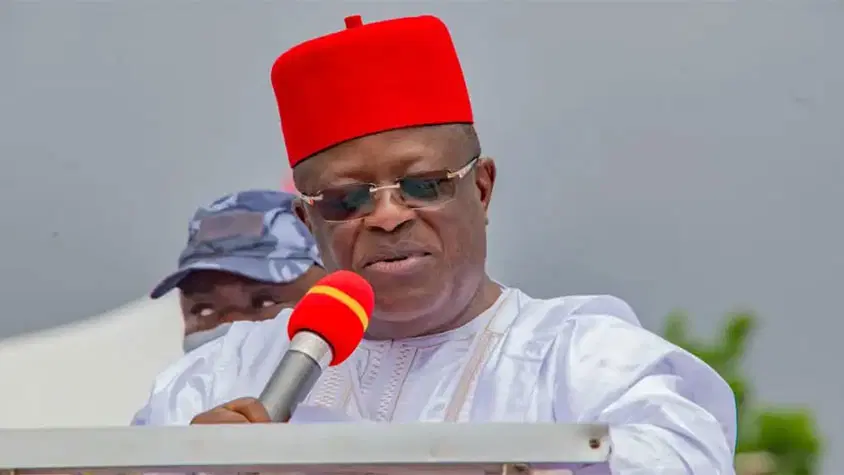
Nigeria Minister of Works, David Umahi, engaged in a tense live debate with Arise TV anchor Rufai Oseni on Tuesday over the costs of the Lagos-Calabar Coastal Highway project, a flagship infrastructure plan under President Bola Tinubu’s administration.....KINDLY READ THE FULL STORY HERE▶
The discussion focused on the project’s reported N15 trillion cost and the transparency of its funding, including a N700 billion loan from the Netherlands. Oseni pressed Umahi for details on the per-kilometer costs and how public funds are being used. Umahi, however, dismissed the questions, calling them “ignorant” and arguing that differences in terrain and unused foreign loans explained variations in costs.
The argument marked the second public clash between the minister and the anchor, highlighting growing scrutiny of Nigeria’s ambitious highway plan. The Lagos-Calabar Coastal Highway is intended to improve connectivity across southern Nigeria, linking major ports, cities, and industrial hubs.
‘Terrain Matters,’ Minister Says
During the live broadcast, Umahi said, “You cannot compare costs kilometer by kilometer without understanding the terrain. Some sections cross rivers, mountains, and wetlands. Costs naturally vary.” He also noted that portions of the foreign loans allocated to the project remain unused, which affects overall expenditure calculations.
Oseni, known for his rigorous questioning style, pushed back, saying taxpayers deserve clear answers about how their money is spent. “We need real evidence of expenses,” he said. “People want accountability. You cannot dismiss questions on costs as ignorance.”
Public Scrutiny Grows
The Lagos-Calabar Coastal Highway, planned to run along Nigeria’s southern coast, has been hailed as a transformative project that could boost trade and ease transport congestion. Yet, it has also drawn criticism over its high cost and delays in funding disclosures.
Experts say transparency is key to maintaining public trust in large-scale infrastructure projects. “When you’re dealing with trillions of naira of public money, Nigerians have a right to see detailed reports,” said Chike Obi, a Lagos-based infrastructure analyst. “Questions about per-kilometer costs and foreign loans are legitimate.”
Political Implications
Observers note that the confrontation between Umahi and Oseni is also politically significant. The government under President Tinubu has been promoting major infrastructure as a central part of its agenda. Public disagreements over project costs, however, risk raising doubts about management and planning.
Umahi, a former governor of Ebonyi State, has defended the project as essential for national development. “This highway is not just concrete and asphalt. It’s about connecting people, creating jobs, and boosting commerce,” he said.
Calls for Transparency
Civil society groups have called for more openness regarding the project. Some suggest a publicly available breakdown of all expenses and loans, arguing that detailed reporting could prevent misinformation and build confidence among Nigerians.
Despite the heated exchange, officials maintain that the project continues according to plan, with construction progressing in phases along the 1,600-kilometer route. Funding is a combination of government allocation and foreign loans, with environmental and engineering considerations adding complexity to cost estimates.
As Nigeria watches the project unfold, the debate between Umahi and Oseni reflects a larger public demand for accountability and clarity in government spending. For many, the Lagos-Calabar Coastal Highway symbolizes both progress and the need for transparent governance.



One of the prospective members of the National Youth Service Corps (NYSC) rescued from kidnappers in Imo State has recounted the horrifying conditions they endured in captivity, revealing that their abductors beat them and forced them to survive on dry garri and dirty water in a forest.....KINDLY READ THE FULL STORY HERE▶
Speaking in an interview with the BBC, the victim disclosed that the kidnappers monitored conversations between captives and their families, assaulting them whenever they were displeased with anything said during the calls.
She was among 20 prospective corps members and another passenger abducted on October 1, 2026, while travelling from Ibadan, Oyo State, to orientation camps in Abia and Akwa Ibom states.
According to her account, the kidnappers allowed the victims to contact their relatives using a phone but subjected them to physical punishment if their conversations provoked the abductors.
She said, “We are given a phone to call our family, and if any family say anything they don’t want to hear or any rubbish that would make them angry, we will be beaten.
“That person will be beaten, used the gun, wood. Sometimes they use their hands to punch them, mostly the guys.”
Recounting the circumstances surrounding the abduction, the victim explained that their journey began at about 9 a.m., with the vehicle making several stops along the way.
She said the driver eventually stopped after reaching a stretch of road considered dangerous, and the passengers were advised to rest before continuing their journey.
The prospective corps member added that she had informed her family they would spend the night in a public place before going to sleep.
However, she said she woke up to find herself caught up in the abduction and could not understand how she had been taken to the forest where they were initially held.
“When I woke up, that was when the incident happened. I don’t know how we got to the forest where we were kept for some time,” she recounted.
The victim said the abductors later moved them further into the forest, where access to food and clean drinking water was severely limited.
Describing their living conditions, she revealed that the captives survived mainly on dry garri and muddy water, despite the poor quality of the water.
“What we are eating there is just garri. Like Igbo garri, dry garri with mud water. Very dirty water. I can’t even give my enemy that water. We don’t have a choice, we have to take it for survival,” she said.
She also described the emotional distress she experienced during captivity, explaining that the situation left her confused, frightened and unable to process what was happening.
“I can’t explain how I felt. I can’t even cry, I was just looking, I was lost. I don’t know what to do,” she said.
“It felt like it was a movie. I don’t believe that this is happening to me.”
The victim further disclosed that she feared she might not survive the ordeal before security operatives intervened.
She expressed gratitude to the government and security personnel, particularly operatives of the Department of State Services (DSS), whom she credited with helping to secure their release.
“The government, the DSS staff, we were rescued by them,” she stated.
The prospective corps members were abducted on October 1 when gunmen reportedly attacked two buses along the Owerri-Onitsha Road near Umunoha in Imo State.
They regained their freedom on October 7 following a coordinated security operation and were subsequently taken to a DSS medical facility in Owerri for treatment.

The Minister of the Federal Capital Territory (FCT), Nyesom Wike, has declared himself the commander of field operations for President Bola Tinubu’s re-election campaign in Abuja ahead of the 2027 general elections.....KINDLY READ THE FULL STORY HERE▶
reports that Wike made the declaration on Monday during a stakeholders’ meeting of the Rainbow Coalition in Abuja.
The meeting was attended by stakeholders from the All Progressives Congress (APC) and the Peoples Democratic Party (PDP), including party chairmen, serving and former senators, National Assembly candidates, and political leaders from the FCT’s six area councils.
Speaking at the gathering, Wike announced plans for a joint mobilisation effort involving APC and PDP members to secure victory for Tinubu in the presidential election and support candidates of the ruling party contesting National Assembly seats in the FCT.
The minister urged participants to prioritise the coalition’s shared political objective over their individual party affiliations.
Wike said the stakeholders had reached a consensus on supporting Tinubu’s re-election bid, adding that he would coordinate political activities in both the FCT and Rivers State.
“For the presidency, all of us have agreed that it is Bola Ahmed Tinubu. I am going to coordinate the FCT and Rivers State. So you can imagine how important it is,” he said.
Emphasising his role in the FCT campaign, Wike added, “I am in charge of the FCT election. I am the commander of field operations as far as the FCT election is concerned.”
He further called on members of both parties to work together, insisting that political differences should not undermine their collective objective ahead of the polls.
“I want to let all of you know that we are going to work together. Nobody should say, ‘I am PDP’ or ‘I am APC.’ For the purpose of this election, we are together,” the minister stated.
Former Minister of Communications and Digital Economy, Professor Isa Ali Ibrahim Pantami, has appealed to his supporters to remain calm following the omission of his name from the Independent National Electoral Commission’s (INEC) final list of candidates for the 2027 Gombe State governorship election.....KINDLY READ THE FULL STORY HERE▶
Pantami, who defected from the All Progressives Congress (APC) to the Peoples Democratic Party (PDP) in May, was absent from the list published by INEC on Saturday.
In a statement shared on his social media platforms, the former minister’s camp described the development as a temporary electoral setback, assuring supporters that efforts were being made to resolve the issue.
The statement, signed by Professor Suleiman Mohammed Gombe, acknowledged the concerns raised by PDP members and supporters of the Pantamiyya Movement both within and outside Gombe State.
According to the statement, Pantami’s legal and liaison teams are engaging relevant PDP organs and INEC to secure compliance with a court order and address the omission within the period allowed by law.
The camp urged supporters to remain optimistic, stressing that the publication of the final list did not bring the matter to a conclusion.
“We are aware of the people working behind the scenes to frustrate good and responsible leadership in Gombe State,” the statement said.
Expressing confidence that the issue would be resolved, the camp encouraged supporters to sustain their mobilisation efforts and remain committed to the movement’s goal of serving humanity.
It also reaffirmed the unity between the PDP and the Pantamiyya Movement, stating that both remained committed to advancing the political aspirations of their supporters in Gombe State.
“No distraction will derail our course, in sha Allah,” the statement added.
-

 latest1 year ago
“Social Media Erupts As Jim Iyke Declares Rita Dominic Nollywood’s Most Beautiful”
-
 latest3 years ago
Edo Political Showdown: Oshiomhole Appears At Presidential Villa As Tinubu Hands APC Gubernatorial Flag To Okpebholo (Photos & Video)
-
 entertainment3 years ago
Love Knows No Age American Woman Defends Marriage To Young Nigerian Man “I’m Not 70”
-
 latest3 years ago
Olumide Akpata Strikes Again: Drops Killer Track, Sends Edo State Into Frenzy!(Video)
-
 Politics3 years ago
Nigerians React As Pastor Adeboye Foresees Passing Away On A Sunday After Enjoying A Satisfying Meal Of Pounded Yam
-
 latest2 years ago
FG Identifies 31 States At Risk Of Heavy Flooding In 2024: See Full List
-
 Politics3 years ago
BREAKING: Inspector-General Of Police Summons Top Police Commanders For Crucial-Security Challenges
-
 latest3 years ago
5 NYSC Corpers Perish In Fatal Road Accident Returning From Camp