
latest
Nigerian Army Debunks Claims of Mass Resignations, Calls Reports Misinformation


Nigerian Army Debunks Claims of Mass Resignations, Calls Reports Misinformation....KINDLY READ THE FULL STORY HERE▶
The Nigerian Army has firmly denied recent claims of mass resignations among its personnel, clarifying that voluntary retirements and discharges are regular procedures conducted according to established guidelines.
Major-General Onyema Nwachukwu, the Director of Army Public Relations, made this announcement in a statement on Sunday. He addressed reports circulating in the media, particularly from sources like SaharaReporters, which cited corruption, low morale, and other internal issues as reasons for the alleged mass exodus of soldiers.
Nwachukwu strongly criticized these reports, describing them as efforts to tarnish the reputation of the military. “The publication is a deliberate attempt to create disaffection and denigrate the patriotic service of our personnel,” Nwachukwu emphasized, stating that the Nigerian Army functions under a voluntary service system, not through forced conscription.
He outlined that the process of voluntary retirement is clearly detailed in the Harmonised Terms and Conditions of Service for both officers and soldiers, with strict adherence to these guidelines.
Routine Discharge Process in the Nigerian Army
Nwachukwu highlighted that the procedures for voluntary disengagement are well-defined and routinely followed, ensuring that soldiers can only retire after meeting their service obligations. “Personnel are at liberty to disengage from time to time in accordance with laid down procedures,” he said, explaining that the discharge of soldiers is neither unusual nor indicative of internal issues.
Furthermore, the army spokesperson explained that personnel discharges—whether voluntary or mandatory—are handled in an organized manner, allowing soldiers to prepare for life after service, including processing entitlements, pensions, and other benefits.
Confidentiality of Personnel Discharges
Addressing the reasons behind soldiers leaving the army, Nwachukwu stated that these are private matters, ranging from voluntary retirements, medical grounds, or even pursuits of other professional interests. He dismissed the narrative that soldiers are leaving due to welfare concerns as a “gross misrepresentation of reality,” reaffirming that the Nigerian Army personnel remain highly motivated.
Nigerian Army’s Welfare and Reforms
Contrary to the reports suggesting poor conditions, Nwachukwu stated that the Nigerian Army, under the leadership of Lt.-Gen. Taoreed Lagbaja, has made significant improvements in the welfare of soldiers. Among these reforms is the Affordable Housing Option for All Soldiers Scheme (AHOOAS), which provides soldiers with decent housing and post-service accommodations.
The Army is also undertaking significant infrastructure upgrades across its formations and barracks, aiming to improve the living conditions of both soldiers and their families. Nwachukwu pointed out that soldiers’ allowances are paid promptly, and additional benefits, such as free medical evacuations and airlifts for troops on leave, are regularly provided.
Enhanced Training and Operational Effectiveness
The Nigerian Army has also placed a high priority on the continuous development of its personnel through regular training, ensuring that both officers and soldiers are equipped with the skills needed to excel in their duties. Additionally, modern combat enablers have been injected into various operational theaters to enhance operational effectiveness.


latest
FIFA President Infantino Under Pressure As Calls Grow For World Cup Deal Documents To Be Released.

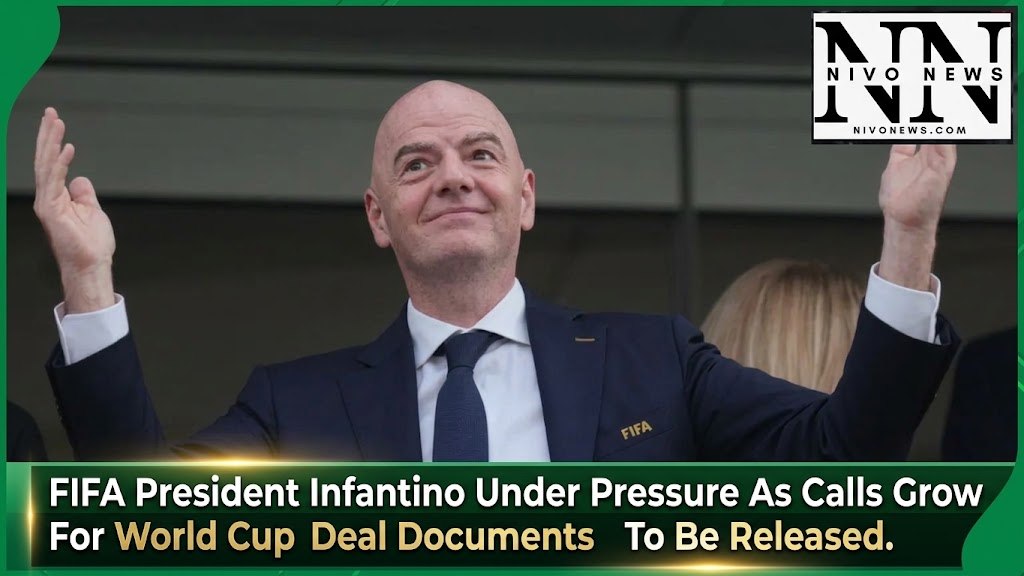
FIFA President Gianni Infantino has been asked to make public documents concerning his abandoned World Cup commercial rights proposal and provide answers to unresolved questions, with his leadership position potentially facing further challenges if he fails to do so.....KINDLY READ THE FULL STORY HERE▶
The demand followed a three-and-a-half-hour meeting of the FIFA Council in Zurich on October 15, the first since details of the controversial FIFA Forward Enterprise (FFE) proposal became public.
The proposal, which Infantino withdrew within days of its disclosure, would have transferred part of FIFA’s commercial rights to a private investment firm.
Football Association chair Debbie Hewitt, who is also a FIFA vice-president, said Infantino apologised during the meeting but did not address questions raised by council members.
According to the BBC, Hewitt expressed disappointment that the council had not received answers to its specific requests, including access to documents relating to the FFE proposal.
“One of the disappointing things is that we didn’t get answers to anything that we had specifically requested; for example, getting the papers from FFE,” Hewitt said.
She explained that she had asked why the documents were not provided but was instead told to submit the questions in writing.
“I think the man has to answer those questions and if he doesn’t answer those questions now, he’s not fit to be FIFA president, and that was what was shared in the meeting,” she added.
Hewitt acknowledged that Infantino had expressed regret but questioned the sincerity of his apology, particularly because he had failed to present the proposal to the council before it became public.
She said council members had openly voiced their concerns about how the matter was handled.
“What he really apologised for was not bringing it to the council. If you regret it that deeply, share it with us,” she stated.
Beyond the controversy surrounding the FFE proposal, the meeting also addressed other issues, including the suspended red-card ban involving United States striker Folarin Balogun, the FIFA Peace Prize and funding for national football associations.
Meanwhile, the Union of European Football Associations (UEFA) has continued to oppose Infantino’s leadership, repeatedly calling for him to resign and preparing criminal legal proceedings against him.
UEFA has also filed claims in three United States courts seeking the disclosure of all documents connected to the FFE proposal.
When asked whether Infantino’s apology had changed her position, Hewitt said she had not received any new information that would alter her assessment of the controversy.
“From my position, nothing has shifted. I’ve no new information that makes me feel any differently, other than we do have an apologetic president,” she said.
The Nigeria Labour Congress (NLC) has rejected the Federal Government’s decision to postpone negotiations for a new national minimum wage until June 2027, insisting that discussions must begin immediately.....KINDLY READ THE FULL STORY HERE▶
The labour union maintained that preparations for a fresh wage agreement should commence without further delay, alongside measures to reduce petrol prices, introduce tax relief and approve wage awards to cushion the effects of rising living costs on workers.
The demands were outlined in a letter dated October 13, 2026, signed by NLC President Joe Ajaero and addressed to the Minister of Labour and Employment, Dr Muhammad Maigari Dingyadi.
The Congress warned that the government’s response failed to adequately address the economic challenges confronting Nigerian workers, raising the possibility of an industrial dispute as its 14-day ultimatum continues.
Although the NLC did not declare a strike in the letter, sources within the union reportedly indicated that industrial action could become an option if the outstanding issues were not resolved before the ultimatum expires.
The Federal Government had argued that the current national minimum wage of ₦70,000, which President Bola Tinubu signed into law on July 29, 2024, would not be due for review until June 1, 2027.
In its response to the union’s earlier demands, the government maintained that the law provides for a minimum wage review every three years, making an earlier exercise premature.
Dingyadi argued that beginning another wage review barely two years after the implementation of the existing agreement could disrupt industrial relations.
“Commencing a fresh review exercise barely two years into the implementation of the current wage, which represented an increase of over 133 per cent from the previous minimum wage of ₦30,000, would be premature, inconsistent with the law, and disruptive to the orderly industrial relations system envisaged by the Act,” the minister stated.
The government also highlighted measures introduced to ease economic hardship, including the Presidential Compressed Natural Gas (CNG) Initiative, food security programmes and other social intervention schemes.
It added that the Ministry of Labour was engaging relevant Ministries, Departments and Agencies to address the remaining demands, while assuring the union that the National Minimum Wage Tripartite Committee would be convened at the appropriate time.
However, the NLC insisted that the government’s response failed to resolve the fundamental issues raised by organised labour.
While acknowledging the ministry’s relatively swift response, the Congress stressed that a prompt reply without concrete action would not provide meaningful relief to workers.
“The Congress notes that, for the first time in recent history, the Ministry has responded with relative speed to our resolutions. We acknowledge this departure from the usual culture of bureaucratic silence,” the letter stated.
It added, “However, while we appreciate this prompt acknowledgement, we are constrained to observe that speed without substance may amount to an empty gesture.”
The union described the government’s position as inconsistent with the principles of law, economic realities and social justice.
At the centre of the disagreement is the interpretation of the National Minimum Wage Act, 2019, as amended in 2024.
While the Federal Government maintains that the next review is due in June 2027, the NLC argues that the timeline should be calculated from the original legislation enacted in 2019.
According to the Congress, the original Act was signed into law on April 18, 2019, meaning that a review was due by April 18, 2024.
“The National Minimum Wage Act, 2019, which the 2024 Amendment Act amended, was signed into law on 18 April 2019. Under the clear provisions of that Act, a review was statutorily due by 18 April 2024,” the union argued.
The NLC maintained that the 2024 amendment did not repeal the original legislation or eliminate the statutory timeline for reviewing the minimum wage.
The union also recalled that organised labour had agreed to reduce retrospective wage arrears during the 2024 negotiations following appeals from the government over the financial burden on employers and public institutions.
It insisted that the concession should not be interpreted as an abandonment of the statutory review timeline.
The Congress further argued that negotiations for a new minimum wage should begin at least six months before the proposed implementation date to prevent delays and the accumulation of unpaid arrears.
Based on this position, the union said negotiations should commence by October 17, 2026.
It clarified that it was not demanding the immediate implementation of a new minimum wage but wanted the negotiation process to begin without further delay.
“The Government is not being asked to implement a new wage immediately, but to commence the negotiation process,” the letter stated.
The proposed steps include obtaining nominations from relevant stakeholders, inaugurating the tripartite committee and establishing an agenda for negotiations.
According to the NLC, beginning the process early would give the government, employers and organised labour sufficient time to agree on a new wage.
NLC Raises Alarm Over Declining Value Of ₦70,000 Minimum Wage
Beyond the legal disagreement, the labour union argued that rising living costs had significantly eroded the purchasing power of the current ₦70,000 minimum wage.
It noted that although the statutory wage increased from ₦30,000 to ₦70,000, workers had not experienced a corresponding improvement in their ability to afford essential goods and services.
The Congress attributed the situation to inflation, the depreciation of the naira and increasing prices of basic commodities.
“The Federal Government must understand that a wage increase immediately eroded by inflation is not a meaningful improvement in workers’ purchasing power; it is merely a statistical illusion. While the nominal wage increased by 133 per cent, real wages have actually declined,” the union stated.
The NLC also blamed rising petrol prices for increasing transportation costs and driving up the prices of food and other necessities.
It said many Nigerian workers were struggling to meet basic expenses, including food, rent, healthcare, education and transportation.
The union further questioned the effectiveness of the CNG initiative, alleging that inadequate infrastructure, gas supply shortages and limited availability of conversion kits had prevented many Nigerians from benefiting fully from the programme.
“Workers cannot feed their families with an initiative that has yet to deliver the promised relief, especially when their children are hungry today,” the letter stated.
NLC Lists Demands, Warns Against Further Delays
The Congress called on the Federal Government to implement immediate measures to ease the economic pressure on Nigerian workers.
Its demands include:
- Petrol price reduction: Lower petrol prices to the level prevailing when the current minimum wage was signed into law in 2024.
- Tax relief: Implement tax relief measures agreed upon in 2023.
- Wage awards: Approve immediate wage awards to help workers cope with rising living costs.
- JOHESU agreement: Implement the terms of settlement reached with the Joint Health Sector Unions.
- JPSNC demands: Resolve outstanding issues raised by the Joint Public Sector Negotiating Council.
- Minimum wage negotiations: Begin discussions on a new national minimum wage without further delay.
The NLC maintained that the government could provide meaningful relief if it demonstrated sufficient political will.
“Procrastination is no longer a policy choice; it constitutes a direct threat to the survival and well-being of Nigerian workers,” the letter stated.
The union also warned that continued discussions without clear timelines or immediate relief measures would fail to address workers’ concerns.
“We acknowledge your assurance that your office remains open to dialogue. However, dialogue without concrete timelines and immediate relief measures amounts to mere rhetoric,” it added.
The Congress reaffirmed its commitment to pursuing improved working conditions and economic relief for Nigerian workers.
However, the letter did not announce a specific date for a strike, leaving the possibility of industrial action dependent on the outcome of engagements with the Federal Government and the expiration of the union’s ultimatum.
latest
2027: Don’t Vote For Someone Who Celebrates Birthdays In IDP Camps Because He Wants To Be President – Wike.
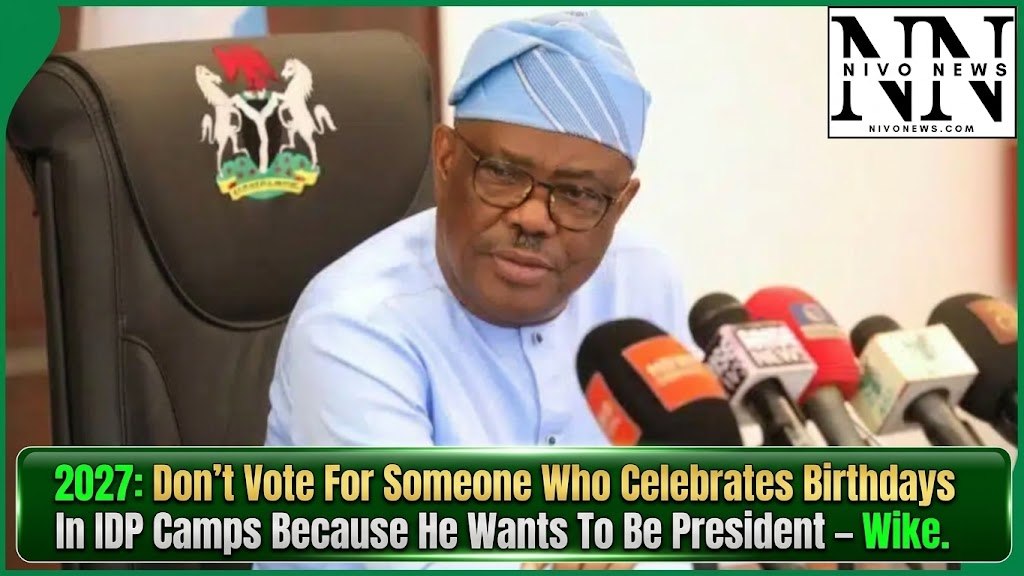
The Minister of the Federal Capital Territory (FCT), Nyesom Wike, has called on Nigerians to reject politicians he described as political gamblers, accusing them of using deception to gain access to public office.....KINDLY READ THE FULL STORY HERE▶
Wike warned Nigerians against taking politicians seriously simply because they visit Internally Displaced Persons (IDP) camps to celebrate their birthdays while seeking the presidency, particularly if they did not demonstrate similar concern for vulnerable citizens while holding public office.
He urged Nigerians to look beyond ethnic sentiments, political calculations and power struggles when choosing their leaders, stressing the need for competence, fairness, accountability and effective service delivery.
The minister made the remarks on Thursday, October 15, 2026, at the inaugural Idoma Hall of Fame induction ceremony, organised as part of the Idoma Centenary Plus celebration.
Speaking on the theme, ‘People, Politics and Power Play in Nigeria: The Agitation for Equity and Fairness’, Wike cautioned against politicians exploiting grievances over marginalisation to advance their personal interests.
He argued that Nigeria’s political future depended on citizens’ ability to distinguish genuine public servants from individuals seeking power for personal or sectional gains.
Wike urged Nigerians to assess the intentions, track records and performance of political leaders rather than allow ethnic loyalty or a sense of entitlement to influence their decisions.
According to him, demands for equity and fairness should not become opportunities for political opportunists to redistribute privileges among competing groups without addressing the underlying problems.
“One of the enduring difficulties of our political life is the tendency to convert public power into private possession,” Wike said.
He explained that when public office became a tool for personal enrichment, government resources were diverted towards private interests, while sectional domination left other citizens feeling excluded from governance.
The FCT minister maintained that Nigeria’s pursuit of fairness would remain unsuccessful if political actors concentrated solely on which ethnic group or region controlled power without examining how that power was exercised.
“If one group replaces another at the table while the benefits remain fundamentally exclusionary, the occupants have changed, but the injustice has not,” he stated.
Wike also challenged Nigerians to demonstrate a consistent commitment to justice, warning against condemning marginalisation only when their own communities were affected.
“If we complain about marginalisation only when our own people are excluded, but become silent when others are marginalised after our people gain power, we are not opposing injustice; we are seeking access to its privileges,” he said.
He stressed that genuine fairness required defending justice even when doing so conflicted with one’s ethnic affiliations or political interests.
The minister further called for a political culture in which public office was treated as a responsibility entrusted to leaders rather than an entitlement, adding that Nigeria’s diversity should strengthen national unity instead of encouraging exclusion.
He noted that the federal character principle enshrined in the 1999 Constitution, as amended, was intended to promote national unity and prevent a small number of states or sectional groups from dominating public institutions.
However, Wike cautioned that the quest for balanced representation must not undermine competence and merit.
“A Nigerian should not be excluded from public office because of where he or she comes from; neither should competence become irrelevant once a candidate’s identity satisfies a representational expectation,” he said.
Wike argued that the success of political leadership should be judged by the tangible improvements it delivers to citizens rather than the identities of those occupying positions of authority.
He listed employment, quality education, healthcare, infrastructure, electricity, security and economic opportunities as essential indicators of meaningful political inclusion.
According to him, appointing a prominent political office-holder from a particular community would offer little benefit if ordinary residents continued to struggle with unemployment, poor public services and economic hardship.
“The real measure of political inclusion is therefore not simply who occupies office, but what the exercise of that office produces for the people,” he said.
The minister acknowledged that Nigeria had introduced several arrangements to accommodate its diversity, including federalism, state creation, revenue allocation, zoning and rotational presidency.
Nevertheless, he maintained that these mechanisms alone could not guarantee fairness without a genuine commitment to serving the public interest.
Wike called for a political system that prioritised the common good and provided every Nigerian with a fair opportunity to participate in national life, regardless of background.
He also criticised the zero-sum approach to politics, in which the progress of one community is perceived as a setback for another, warning that such thinking threatens national unity.
He urged political leaders to strengthen institutions that serve the entire country rather than promote arrangements that favour only their supporters or ethnic constituencies.
-

 latest1 year ago
“Social Media Erupts As Jim Iyke Declares Rita Dominic Nollywood’s Most Beautiful”
-
 latest3 years ago
Edo Political Showdown: Oshiomhole Appears At Presidential Villa As Tinubu Hands APC Gubernatorial Flag To Okpebholo (Photos & Video)
-
 entertainment3 years ago
Love Knows No Age American Woman Defends Marriage To Young Nigerian Man “I’m Not 70”
-
 latest3 years ago
Olumide Akpata Strikes Again: Drops Killer Track, Sends Edo State Into Frenzy!(Video)
-
 Politics3 years ago
Nigerians React As Pastor Adeboye Foresees Passing Away On A Sunday After Enjoying A Satisfying Meal Of Pounded Yam
-
 latest3 years ago
FG Identifies 31 States At Risk Of Heavy Flooding In 2024: See Full List
-
 Politics3 years ago
BREAKING: Inspector-General Of Police Summons Top Police Commanders For Crucial-Security Challenges
-
 latest3 years ago
5 NYSC Corpers Perish In Fatal Road Accident Returning From Camp