
latest
IBEDC Customers To Experience Power Outage As TCN Announces Maintenance.


The Transmission Company of Nigeria (TCN) has announced a scheduled six-hour power outage affecting parts of Ogun State on Thursday, May 14, 2026.....KINDLY READ THE FULL STORY HERE▶
latest
WAR ON DRUGS INTENSIFIES! Federal Government Declares Zero Tolerance As New Anti-Abuse Offensive Begins!.

The Federal Government has reaffirmed its resolve to combat illicit drug use and trafficking in Nigeria, emphasizing a multi-pronged approach that includes dismantling trafficking networks, enhancing treatment for addiction, and safeguarding public well-being. This commitment was expressed on July 8, 2026, by the Secretary to the Government of the Federation (SGF), Senator George Akume, at the National Drug Use Summit in Abuja, which was organized by the NDLEA, the Federal Ministry of Health and Social Welfare, and the UNODC.....KINDLY READ THE FULL STORY HERE▶
Representing the SGF, Dr. Adamu Ibrahim Kana noted that the administration is dedicated to preventing drug abuse and aiding the recovery of those struggling with addiction as part of its “Renewed Hope Agenda”. Key takeaways from the summit and official updates include:
-
Collaborative Action: NDLEA Chairman Brigadier General Mohamed Buba Marwa (retd.) emphasized that while the agency has made progress, the complex challenge of drug abuse requires a collective response from families, traditional leaders, government institutions, and the private sector.
-
Enforcement Achievements: Over the past 18 months, the NDLEA has arrested 29,262 suspects, seized over 5.3 million kilograms of illicit drugs valued at more than N1.5 trillion, and secured 5,225 convictions.
-
Prevention and Care: The NDLEA has conducted 6,645 awareness campaigns reaching nearly five million people and provided counseling, treatment, and rehabilitation to 13,508 individuals across its 31 centers.
-
Strategic Initiatives: The agency has introduced an “Alternative Development Initiative” to support cannabis farmers in transitioning to legal and sustainable livelihoods.
-
Future Goals: Health Minister Professor Ali Pate and representatives from the UNODC stressed the need for the summit to yield practical, measurable outcomes, including a reinforced National Action Plan to address evolving drug use patterns in the country.

Benjamin Kalu, the Deputy Speaker of the House of Representatives, recently shared details about his interaction with Adeniyi Adeyemi, the individual posing as the Director General of the Presidential Foreign Intervention Promotion Council (PFIPC). During Wednesday’s plenary session, Kalu identified himself as one of the victims of Adeyemi’s deceptive activities, noting that images of them together have been widely circulated in the media.....KINDLY READ THE FULL STORY HERE▶
-
Initial Correspondence: In May 2025, Kalu’s office received a letter on what appeared to be official Presidency letterhead, claiming to be from the office of the PFIPC Director General.
-
Verification Attempts: Kalu found the information provided in the letter contradictory and questionable, prompting him to send his team to the listed address at the Federal Secretariat Complex in Abuja to confirm the organization’s legitimacy.
-
False Confirmation: Because his team reported that the organization was present at the specified location, Kalu subsequently granted approval for an interaction with the individual.
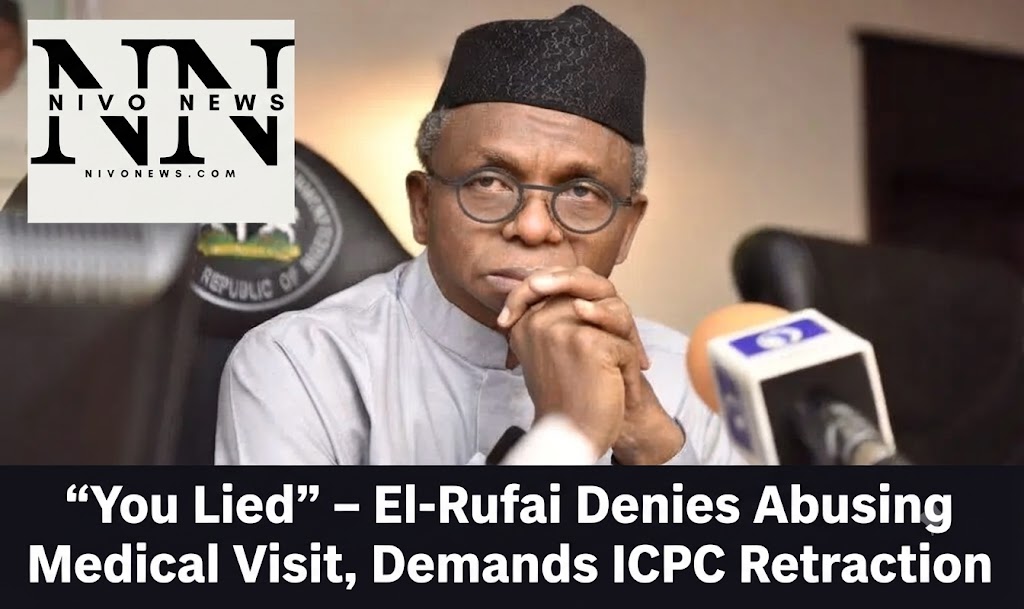
Former Kaduna State Governor, Nasir El-Rufai, has formally rejected claims by the Independent Corrupt Practices and Other Related Offences Commission (ICPC) that he misused a court-approved medical visit while in detention, characterizing the agency’s account as a misrepresentation of both law and fact. Through his media adviser, Muyiwa Adekeye, the former governor has called for the immediate release of his personal physician, Professor Bello Abubakar, and requested that the ICPC retract its allegations regarding the violation of a court order.....KINDLY READ THE FULL STORY HERE▶
-
Medical Justification: El-Rufai’s representatives state that his inability to attend court on July 6 resulted from ongoing health issues that were communicated to the ICPC beforehand. They further assert that his personal doctor had been previously denied access to him at the commission’s facility, contradicting claims that the medical visit was a ploy to avoid court proceedings.
-
Interpretation of Court Orders: Adekeye disputed the ICPC’s allegation that a court order was breached, arguing that the April 1, 2026, order by Justice R.M. Aikawa grants El-Rufai the right to medical care without placing restrictions on visitors during those sessions.
-
Rejection of Political Claims: The former governor’s camp dismissed the description of the hospital visit as a political meeting, noting that it was the ICPC that rescheduled the appointment to a busier morning time slot and that commission staff were present throughout the duration of the visit.
-
Legal Rights and Compliance: El-Rufai’s team emphasized that medical access is a legal right, supported by the Nelson Mandela Rules and the existing court order. They warned that further efforts by the ICPC to restrict his access to family, legal counsel, or medical care could constitute contempt of court.
-

 latest11 months ago
“Social Media Erupts As Jim Iyke Declares Rita Dominic Nollywood’s Most Beautiful”
-
 latest2 years ago
Edo Political Showdown: Oshiomhole Appears At Presidential Villa As Tinubu Hands APC Gubernatorial Flag To Okpebholo (Photos & Video)
-
 entertainment2 years ago
Love Knows No Age American Woman Defends Marriage To Young Nigerian Man “I’m Not 70”
-
 latest2 years ago
Olumide Akpata Strikes Again: Drops Killer Track, Sends Edo State Into Frenzy!(Video)
-
 Politics3 years ago
Nigerians React As Pastor Adeboye Foresees Passing Away On A Sunday After Enjoying A Satisfying Meal Of Pounded Yam
-
 latest2 years ago
FG Identifies 31 States At Risk Of Heavy Flooding In 2024: See Full List
-
 Politics3 years ago
BREAKING: Inspector-General Of Police Summons Top Police Commanders For Crucial-Security Challenges
-
 latest2 years ago
5 NYSC Corpers Perish In Fatal Road Accident Returning From Camp