
latest
Alao-Akala Family Feud Explodes: Court Battle Reveals Late Governor’s Vast Properties Across Nigeria & Abroad.


A legal dispute over the estate of former Adebayo Alao-Akala has unveiled a vast portfolio of properties owned by the late governor across Nigeria and abroad.....KINDLY READ THE FULL STORY HERE▶

The Pentecostal Fellowship of Nigeria (PFN) has formally dismissed assertions that its recent national prayer initiative was connected to Pastor Enoch Adeboye or the Redeemed Christian Church of God (RCCG). Describing these claims as “false, misleading, and entirely baseless,” the PFN emphasized that the fellowship solely conceived and managed the programme.....KINDLY READ THE FULL STORY HERE▶
-
Sole Authority: PFN National Secretary, Bishop David Bakare, stated that all operational decisions and directives for the event originated exclusively from the PFN leadership.
-
Member Compliance: While the RCCG participated, they did so only by following the PFN’s official directives as a member of the pentecostal community.
-
Global Context: The fellowship noted that the final day of the prayer programme aligned with Pentecost Sunday, a global Christian observance celebrated by many denominations worldwide.
-
Operational Adjustments: The PFN clarified that earlier plans involving public processions and placards were abandoned due to security concerns.
-
Call for Unity: The PFN expressed satisfaction with the event’s success and urged Nigerians to ignore misinformation, encouraging a focus on peace and national progress instead.
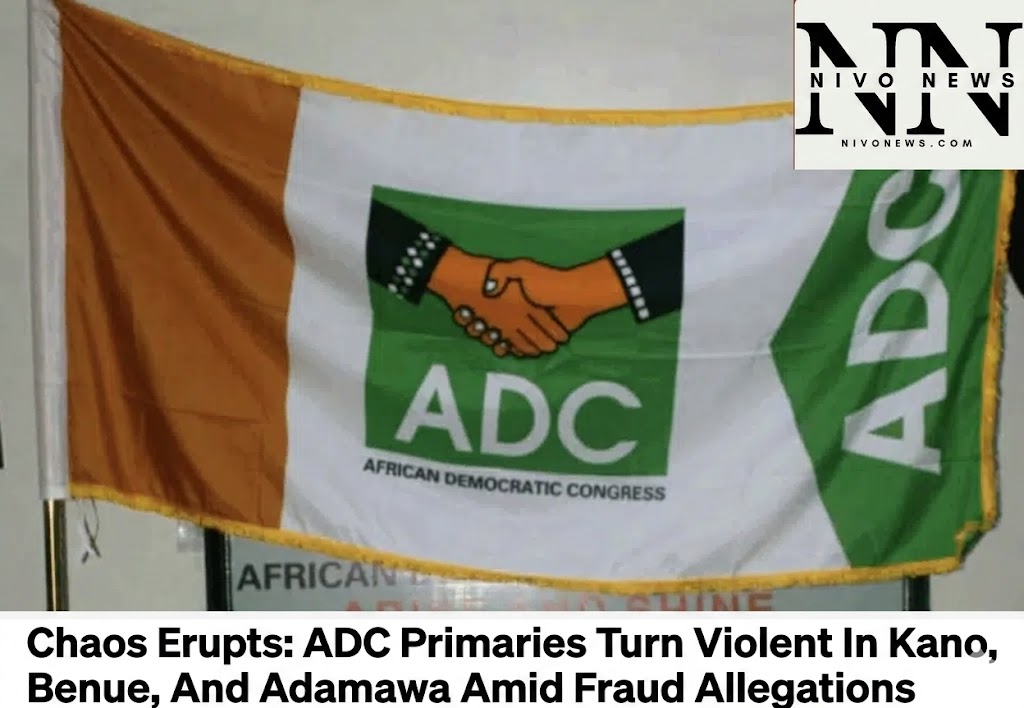
The African Democratic Congress (ADC) is facing significant internal turmoil following its recent primaries, with aspirants in Kano, Benue, and Adamawa states rejecting the results due to alleged irregularities.....KINDLY READ THE FULL STORY HERE▶
-
-
Kano State: Aspirants, organized as the “Concerned ADC Aspirants and Stakeholders,” claimed the primaries lacked credibility because they were reportedly held while screening was still ongoing. The State Chairman, Musa Ungogo, refuted these claims, asserting that due process was followed and that consensus-building efforts remain in progress.
-
Benue State: At least nine House of Representatives aspirants have filed formal petitions with the party’s appeal panel. Disgruntled participants, such as Inalegwu Ejembi, described the event as a “shame,” alleging that the elections never actually took place.
-
Adamawa State: House of Representatives aspirant Ahmed Bashir has declared his intention to challenge the primary results in court. He alleged that he faced pressure to withdraw in favor of Adamu Atiku—the son of the party’s presidential candidate—and claimed he was denied access to the party’s appeal committee. Conversely, the Adamawa State ADC Secretary, Shagna Pwamaddi, defended the process, insisting the primaries were free and fair.
Option 2: Concise Narrative
Post-primary crises are intensifying within the ADC as candidates from three key states challenge the legitimacy of the selection process. In Kano, aspirants are demanding an investigation into the credibility of the May 21 exercise, while party leadership maintains that all procedures were conducted properly. Meanwhile, in Benue, multiple candidates have petitioned the party’s appeal panel, asserting that no real election occurred. The situation in Adamawa has escalated to a potential legal battle, with an aspirant accusing the party of forcing him to step down to benefit a specific candidate, a claim the state party secretary has firmly denied.
-
latest
Cooking Gas Nightmare: Prices Skyrocket To ₦2,400/kg As Households Abandon Clean Energy For Firewood.

Nigerians across major urban centers are facing severe financial strain as the price of Liquefied Petroleum Gas (LPG) continues to soar, reaching as high as ₦2,400 per kilogramme in certain retail markets. While prices at established filling stations currently range between ₦1,650 and ₦1,900 per kilogramme, neighborhood retailers and black-market operators have pushed costs significantly higher, citing local logistics and overhead expenses.....KINDLY READ THE FULL STORY HERE▶
The Nigerian Association of Liquefied Petroleum Gas Marketers (NALPGAM) reports that supply volatility and high procurement costs—with marketers paying over ₦25 million for 20 metric tonnes—are primary drivers of the price surge. Consequently, many households are abandoning clean cooking energy in favor of charcoal or firewood, a trend that threatens government initiatives to promote safer energy alternatives.
The rising cost of cooking gas has become a major source of hardship for Nigerian families already battling inflation in food and transport sectors. Consumers in cities like Ibadan and Lagos report that prices are fluctuating rapidly, making it difficult to maintain standard cooking habits.
For example, residents noted that prices which were around ₦1,000–₦1,200 earlier in the year have jumped significantly, leading some to stop using gas entirely. Small-scale retailers argue that high transportation costs, such as the expense of moving product via motorcycle, leave them with no choice but to sell at premium rates. As costs reach prohibitive levels, low-income families are increasingly turning to traditional, less environmentally friendly fuel sources like firewood to survive.
Key Takeaways
-
Price Disparity: Consumers face a wide price range, with retail costs reaching ₦2,400/kg in some areas, while filling stations generally charge between ₦1,650 and ₦1,900/kg.
-
Logistical Challenges: Resellers cite high transportation and operational overheads as major reasons for the inflated prices at the local level.
-
Market Instability: Despite increased domestic production, NALPGAM highlights that erratic supply and high wholesale costs are keeping retail prices high.
-
Behavioral Shift: The persistent price hikes are forcing many citizens to revert to charcoal and firewood, potentially reversing progress made in clean energy adoption.
-

 latest10 months ago
“Social Media Erupts As Jim Iyke Declares Rita Dominic Nollywood’s Most Beautiful”
-
 latest2 years ago
Edo Political Showdown: Oshiomhole Appears At Presidential Villa As Tinubu Hands APC Gubernatorial Flag To Okpebholo (Photos & Video)
-
 entertainment2 years ago
Love Knows No Age American Woman Defends Marriage To Young Nigerian Man “I’m Not 70”
-
 latest2 years ago
Olumide Akpata Strikes Again: Drops Killer Track, Sends Edo State Into Frenzy!(Video)
-
 Politics2 years ago
Nigerians React As Pastor Adeboye Foresees Passing Away On A Sunday After Enjoying A Satisfying Meal Of Pounded Yam
-
 latest2 years ago
FG Identifies 31 States At Risk Of Heavy Flooding In 2024: See Full List
-
 Politics2 years ago
BREAKING: Inspector-General Of Police Summons Top Police Commanders For Crucial-Security Challenges
-
 latest2 years ago
5 NYSC Corpers Perish In Fatal Road Accident Returning From Camp