
latest
Lagos–Ibadan Rail Becomes Nigeria’s New Economic Lifeline

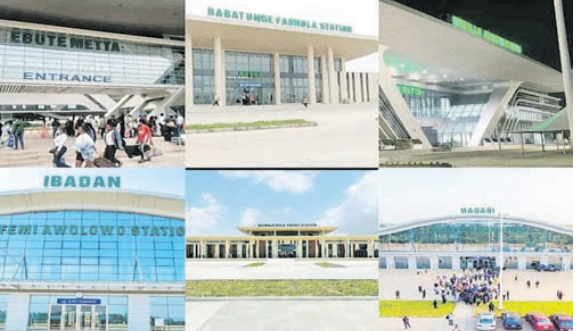
Once dismissed as a white-elephant project, the Lagos–Ibadan railway has become a symbol of efficiency and a major driver of economic growth in the Southwest. In just the first eight months of 2025, the line transported nearly 700,000 passengers and moved over 380,000 tons of cargo, saving millions of travel hours and drastically cutting haulage costs in a country long constrained by poor road networks and rising logistics expenses.....KINDLY READ THE FULL STORY HERE▶
On a recent morning in Ibadan, the train pulled into the terminal with its usual punctuality. Commuters ranging from civil servants and traders to students stepped out after completing the 120-kilometre journey from Lagos in just over two hours—a trip that once took up to half a day by road. The convenience has transformed daily routines, allowing workers to reach offices earlier, traders to open shops on time, and students to save both money and energy.
Between January and August 2025, official records showed that 690,169 passengers used the service, with ridership rising steadily from 79,672 in January to over 109,000 in August—a 37 per cent growth in less than a year. Economists note that such time savings translate into measurable productivity. With each passenger saving about two hours per trip, the economy effectively regained more than 1.4 million productive hours in just eight months, the equivalent of 160 years of labour time.
The freight operations have been equally impactful. In the same period, the rail line hauled 382,340 tons of cement, steel, gypsum, containerised goods, and other commodities crucial to Nigeria’s industries. In April alone, more than 73,000 tons moved on the corridor. This shift from road to rail has not only eased congestion on the Lagos–Ibadan expressway but also reduced transport costs and prevented perishable goods from rotting in gridlock. Traders say the benefits are clear, with produce reaching markets faster, fresher, and in larger quantities, thereby improving profit margins.
Economists describe railways as transformative infrastructure with far-reaching economic multipliers. Passenger fares and freight receipts on the Lagos–Ibadan line generated about ₦12 billion in the first eight months of 2025, which, when combined with the spillover effects in agriculture, manufacturing, and services, translates into tens of millions of dollars in additional value. Around the corridor, communities such as Abeokuta, Papalanto, and Moniya are experiencing a resurgence, with land values rising and businesses springing up around the stations.
The rail line has also helped stabilise food supply and prices, cutting wastage and supporting efforts to keep inflation in check. Nigeria’s inflation, which eased to 20.1 per cent in August, is being cushioned partly by improvements in transport efficiency along critical corridors like Lagos–Ibadan. Each commuter who saves hours of travel and every ton of freight delivered more cheaply adds to the productivity gains and cost reductions shaping the broader economy.
Government reforms are amplifying this momentum. Through the Track Access Programme, the Nigerian Railway Corporation has opened its lines to licensed operators, with Lagos already linking its Red Line service to the corridor and Chinese partners piloting freight operations. The initiative is attracting private investment while reducing the financial strain on the government.
In addition, partnerships with Ajaokuta Steel Company aim to produce train components locally, supporting Nigeria’s steel industry, while collaborations under the Presidential Initiative on Compressed Natural Gas will convert locomotives into gas-powered hybrids to cut emissions and lower operating costs. Technical institutions are also being engaged to train a new generation of engineers, ensuring that the human capital needed to sustain the sector is developed alongside physical infrastructure.
Despite its success, challenges remain. Limited daily trips, low awareness among potential passengers, and poor road connectivity to some stations have slowed the full economic potential of the line. Local operators and residents argue that more trips, better publicity, and supporting infrastructure such as hotels, malls, and roads are necessary to maximise the benefits. Concerns about safety and maintenance funding also linger, with experts stressing the importance of governance and consistent investment to keep the service reliable.
The Lagos–Ibadan line, part of the larger Lagos–Kano–Maradi corridor envisioned under the African Continental Free Trade Area, is being positioned as a backbone for West African trade. Leaders have underscored its potential to integrate markets, link farmers to consumers, and strengthen Nigeria’s role as a regional logistics hub.
As the trains continue to glide across the corridor each day, the project is proving to be far more than a transport service. It is gradually emerging as a catalyst for productivity, price stability, regional integration, and national renewal in a country seeking to diversify beyond oil and build a sustainable path to growth.
latest
Setting The Record Straight: Nnamdi Kanu’s Wife Breaks Her Silence On Shocking Divorce Rumors!.

Uchechi Kanu, wife of the incarcerated Indigenous People of Biafra (IPOB) leader Nnamdi Kanu, has dismissed viral allegations that she has filed for divorce. Addressing the reports on her verified X handle, she reacted with irony, stating that she had only just “learned” about the purported divorce proceedings while her husband remains imprisoned. The rumors, which gained traction online, claimed that years of alleged infidelity, financial neglect, and interference from Nnamdi Kanu’s family had irreparably damaged the marriage. These reports further alleged a history of extramarital affairs by Kanu, including a past relationship with a woman named Chioma Amaryllis Ahaghotu prior to his 2015 arrest. Nnamdi Kanu is currently serving a life sentence at the Sokoto Custodial Centre following a terrorism conviction linked to his Biafran agitation.....KINDLY READ THE FULL STORY HERE▶
Uchechi Kanu has publicly rubbished claims that she is divorcing her husband, IPOB leader Nnamdi Kanu, who is presently serving a life sentence at the Sokoto Custodial Centre. In a sarcastic post on X, she questioned the reports of her filing for a divorce. The rumors had suggested that the marriage, which began in 2009, had collapsed due to financial issues, family interference, and claims of infidelity involving Kanu and another woman, Chioma Amaryllis Ahaghotu.
Option 3: Formal/Reflective
In response to widespread speculation regarding her marital status, Uchechi Kanu has refuted allegations that she initiated divorce proceedings against her husband, Nnamdi Kanu. The IPOB leader, who is currently serving a life term for terrorism, was the subject of reports claiming that Uchechi had endured years of emotional strain, financial neglect, and alleged promiscuity. Specifically, those reports cited an alleged prior involvement between the IPOB leader and a woman named Chioma Amaryllis Ahaghotu as a contributing factor to the marital breakdown. Uchechi Kanu used her official X account to characterize these reports as false, humorously noting that the news of her own divorce was something she was only just learning about.
latest
Who Really Controls Security? Gov. Makinde Reveals The Secret Limitations Of State Governors..

Oyo State Governor and Allied Peoples Movement (APM) presidential candidate, Seyi Makinde, has argued that Nigerian governors lack the constitutional authority to issue operational commands to security agencies, despite being officially labeled the chief security officers of their states. Speaking after a meeting with Bauchi State Governor Bala Mohammed, Makinde explained that he cannot directly instruct the state’s Commissioner of Police, the DSS, or military commanders without clearance from their respective national headquarters. He contended that this disconnect between responsibility and authority is a primary reason why state policing is necessary. Furthermore, Makinde criticized the tendency to hold governors solely accountable for security failures, noting the contrast in public reactions between the Chibok abductions during the Jonathan administration and recent incidents in Oyo. He promised that an APM presidency would ensure that governors are granted the authority required to match their security responsibilities.....KINDLY READ THE FULL STORY HERE▶
During a visit to Bauchi State, APM presidential candidate Seyi Makinde highlighted the limitations governors face regarding national security, stating they cannot direct the police, DSS, or military without federal approval. While acknowledging that governors can impose curfews, he noted that such actions must be balanced against economic realities. Addressing security challenges in Oyo, including the recent abduction of schoolchildren, Makinde called for a comprehensive overhaul of Nigeria’s security architecture to better align institutional authority with the duties expected of state leaders. Bauchi State Governor Bala Mohammed, who hosted the meeting, praised the collaboration and expressed his belief that the APM is strengthening its position as a major opposition party ahead of the 2027 elections.
Option 3: Formal/Policy-Oriented
Governor Seyi Makinde of Oyo State has formally challenged the current security framework in Nigeria, asserting that state governors are effectively powerless to direct federal security formations. During his discussions in Bauchi, the APM flag bearer emphasized that without federal clearance, governors cannot exercise operational control over the police, DSS, or military. Makinde advocated for a structural review of the nation’s security architecture, asserting that the current system unfairly places the burden of security on governors who lack the corresponding power to act. Regarding the upcoming 2027 election, Makinde stated that consultations for his running mate are still ongoing, while Governor Bala Mohammed emphasized the importance of such peer-review meetings in enhancing governance and positioning the APM as a robust political platform.
latest
Saving the NYSC: Can Gowon And Former Presidents Rescue The Nation’s Flagship Youth Program?.

The National Alliance for Democracy (NAD) has formally requested that General Yakubu Gowon—the founder of the National Youth Service Corps (NYSC)—and Nigeria’s former Presidents intervene in the government’s proposed reforms of the scheme. The group expressed fears that modifications approved by the Federal Executive Council (FEC) might jeopardize the NYSC’s core mission of promoting national unity and cohesion. NAD National Convener, Dr. Lucky Eremosele, argued that while modernization is necessary, changes should not prioritize commercial interests or specialized skills at the expense of the programme’s mandate to foster integration among Nigeria’s diverse populations. The organization is calling for an urgent meeting between elder statesmen and President Bola Tinubu to ensure that any restructuring aligns with the scheme’s original philosophy and the broader national interest.....KINDLY READ THE FULL STORY HERE▶
The National Alliance for Democracy (NAD) is urging Nigeria’s past leaders, including General Yakubu Gowon, to engage President Bola Tinubu regarding recent plans to reform the NYSC. Concerned that the current reform path could dilute the scheme’s ability to serve as a nation-building tool, NAD advocates for a more inclusive consultation process that involves the founding generation, youth groups, and civil society. The group warns that shifting the NYSC’s focus too heavily toward specialized career streams or technology-driven models could inadvertently weaken inter-ethnic exposure and national reconciliation. Ultimately, NAD emphasizes that the intervention of former Presidents is essential to provide the historical perspective needed to safeguard the NYSC’s “soul”.
Option 3: Policy-Oriented Perspective
The National Alliance for Democracy (NAD) has issued a formal appeal for high-level intervention in the ongoing reform of the National Youth Service Corps (NYSC). Characterizing the NYSC as a vital instrument for post-civil war reconciliation and national integration, the group argues that executive-led changes must undergo a rigorous review to avoid undermining national unity. NAD identified several risks in the proposed reforms, including the potential for increased inequality through specialized career streams and reduced exposure to Nigeria’s ethno-religious diversity due to changes in deployment models. By calling upon General Gowon and other former heads of state, the alliance aims to secure a consultative reform process that prioritizes national interest, graduate welfare, and institutional integrity.
-

 latest11 months ago
“Social Media Erupts As Jim Iyke Declares Rita Dominic Nollywood’s Most Beautiful”
-
 latest2 years ago
Edo Political Showdown: Oshiomhole Appears At Presidential Villa As Tinubu Hands APC Gubernatorial Flag To Okpebholo (Photos & Video)
-
 entertainment2 years ago
Love Knows No Age American Woman Defends Marriage To Young Nigerian Man “I’m Not 70”
-
 latest2 years ago
Olumide Akpata Strikes Again: Drops Killer Track, Sends Edo State Into Frenzy!(Video)
-
 Politics3 years ago
Nigerians React As Pastor Adeboye Foresees Passing Away On A Sunday After Enjoying A Satisfying Meal Of Pounded Yam
-
 latest2 years ago
FG Identifies 31 States At Risk Of Heavy Flooding In 2024: See Full List
-
 Politics3 years ago
BREAKING: Inspector-General Of Police Summons Top Police Commanders For Crucial-Security Challenges
-
 latest2 years ago
5 NYSC Corpers Perish In Fatal Road Accident Returning From Camp