
Latest News
DSS Forced Me to Speak Against My Will” — Nnamdi Kanu Unveils Harrowing Ordeal

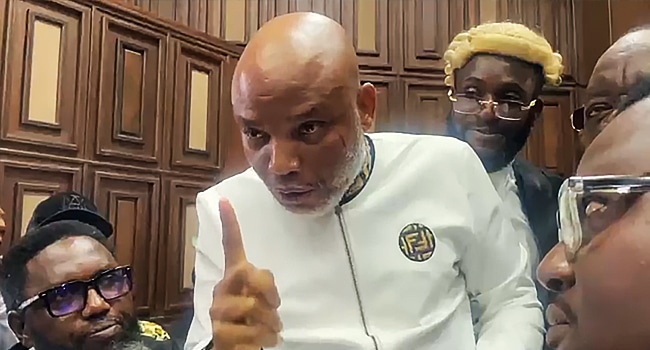
The leader of the Indigenous People of Biafra (IPOB), Nnamdi Kanu, told a Federal High Court in Abuja that operatives of the Department of State Services (DSS) threatened and coerced him into making confessional statements following his arrest in 2015.....KINDLY READ THE FULL STORY HERE▶
Kanu made these claims on Wednesday after the prosecution called its third witness, identified only as CCC, who testified that he was part of the DSS team that interrogated Kanu between October 21 and November 4, 2015. The witness stated that all interrogation sessions were video recorded and that Kanu wrote statements after each session. The federal government’s counsel, Adegboyega Awomolo (SAN), presented two video compact discs (CDs) and three written statements allegedly authored by Kanu as evidence.
Initially, the defence raised no objections. However, Paul Erokoro (SAN), representing Kanu, later challenged the admissibility of the written statements, arguing they were made under duress and without legal representation.
“The DSS denied my client access to his lawyer, threatened to withhold bail, and refused to grant him his medically recommended daily one-hour fresh air due to his health condition,” Erokoro told the court.
Justice James Omotosho subsequently ordered a trial-within-a-trial to determine if Kanu’s statements were given voluntarily.
Inside the Trial-Within-a-Trial
During the separate proceeding, DSS witness CCC insisted that Kanu’s statements were made voluntarily. Under cross-examination, he admitted he had no direct contact with Kanu in his detention cell but was aware of the officers who did.
Erokoro questioned further: “If any DSS officer named Mr. Brown visited the defendant in his cell to threaten him, you wouldn’t know?”
CCC responded, “The DSS does not operate in that manner.”
Kanu himself testified that the coercion began in Lagos, where he was chained, blindfolded, and flown to an unknown destination. Upon arrival in Abuja, he said he was held in solitary confinement in complete darkness.
He accused a DSS officer named Mr. Brown, reportedly the Assistant Director of Investigations, of threatening him, stating:
“Mr. Brown threatened me that if I didn’t comply with their demands, they would stop allowing me my one-hour daily break,” referring to a fresh air allowance recommended by the facility’s medical doctor due to his health issues, including nosebleeds and poor cell conditions.

Questions have been raised over the Nigerian National Petroleum Company Limited’s (NNPCL) reported expenditure of ₦11.2 trillion on pipeline surveillance and security-related activities in 2025.....KINDLY READ THE FULL STORY HERE▶
The concerns followed the release of the company’s 2025 audited financial statements, with energy experts demanding greater transparency on how the money was spent and the value Nigeria derived from the expenditure.
NNPCL reported a 33 per cent increase in Profit After Tax (PAT), which rose from ₦5.4 trillion in 2024 to ₦7.2 trillion in 2025.
However, the company’s revenue declined by 24 per cent to ₦34.5 trillion during the same period.
The financial statements showed ₦11.2 trillion under the heading, “pipeline surveillance and other receivables from federation.”
NNPCL explained that the figure represented advance payments to the Federation as well as costs incurred in securing the country’s oil and gas assets.
The company also clarified that it did not record expenditure under “energy security,” a term it uses in relation to spending associated with fuel subsidy.
The ₦11.2 trillion figure has nevertheless attracted significant attention because it exceeds NNPCL’s ₦7.2 trillion profit for the year.
In 2024, NNPCL reported ₦7.1 trillion in energy security expenditure, while its combined spending on pipeline security was put at ₦17.5 trillion.
Former Vice President and 2027 African Democratic Congress (ADC) presidential candidate, Atiku Abubakar, recently called on the administration of President Bola Tinubu to explain how the ₦11.2 trillion was spent.
Atiku argued that the expenditure required proper scrutiny, noting that the amount was several times higher than Nigeria’s defence budget allocation of approximately ₦3.1 trillion.
Energy expert and petroleum economist, Professor Wumi Iledare, said the focus should go beyond the size of the expenditure to determine the actual value Nigeria received from the spending.
Speaking on Arise, Iledare said NNPCL should demonstrate the benefits derived from the funds used to secure the country’s oil assets.
“The magnitude must be questioned. And those are professional scepticism that NNPC is willing to look at,” he said.
Iledare asked what Nigeria had gained from the ₦11.2 trillion expenditure, noting that resources could either be used to increase production or ensure the uninterrupted flow of crude from existing assets.
Other experts have similarly questioned the spending while acknowledging the importance of protecting Nigeria’s oil and gas infrastructure.
‘Government Stashing Funds For 2027’
In a separate interview with Daily Post, Managing Partner of BBH Consulting and Convener of the Public Interest Advocacy Network (PIAN), Barrister Ameh Madaki, described the reported expenditure as excessive.
Madaki questioned the effectiveness and value of the pipeline surveillance arrangements, while also demanding accountability over the funds.
He asked why NNPCL would spend ₦11.2 trillion on pipeline surveillance across the Niger Delta.
Madaki further alleged that the expenditure could be connected to political preparations ahead of the 2027 general elections, although the claim has not been independently established.
“Every discerning Nigerian knows that this unaccountable government is stashing funds away for the 2027 elections and massive vote-buying under the guise of a criminal pipeline surveillance system which has nothing to offer,” he alleged.
However, oil and gas consultant and public affairs analyst, Chuks Emeka, offered a different perspective, stressing that securing Nigeria’s oil infrastructure was necessary but insisting that the expenditure must be transparent.
Emeka said pipeline vandalism, crude oil theft and attacks on critical infrastructure could negatively affect oil production, discourage investment and reduce government revenue.
“My position is that the security of Nigeria’s oil and gas infrastructure is absolutely necessary,” he said.
He, however, cautioned against presenting the entire ₦11.2 trillion as fresh cash spent exclusively on pipeline security.
According to Emeka, the 2025 audited accounts classified the amount as receivables from the Federation, covering advances and costs incurred on behalf of the government, including expenses associated with protecting oil and gas assets.
“It should therefore not simply be presented as N11.2 trillion in fresh cash spent solely on pipeline security in 2025,” he said.
Despite this clarification, Emeka agreed that Nigerians deserved a detailed breakdown of how the funds were utilised.
He asked how much was spent on surveillance, security operations, community-based surveillance and other interventions, as well as details of contracts awarded, beneficiaries and the measurable results achieved.
‘Security Spending Must Not Become Blank Cheque’
Emeka also noted that improved security around oil infrastructure appeared to have contributed to increased crude oil production.
He said NNPCL reported that average crude production had risen from the low levels recorded in 2022 to about 1.71 million barrels per day in 2025.
“There is evidence that improved pipeline security has contributed to increased crude production,” he said.
Emeka stressed that he was not opposed to spending money to secure Nigeria’s pipelines, but maintained that the country must determine whether it was receiving value commensurate with the funds being committed.
He called for a security model capable of protecting oil facilities, keeping production infrastructure operational and giving host communities a meaningful role in safeguarding the assets.
He added that such a system must be transparent, independently audited and economically efficient.
“At a time when Nigerians are facing significant cost-of-living pressures, every trillion naira committed by the government must be subjected to rigorous scrutiny,” Emeka said.
“Security is necessary, but security spending should not become a blank cheque.”
According to him, the central issue is not whether Nigeria should invest in pipeline security, but how much is being spent, who is receiving the funds, how the money is being utilised and what measurable benefits the country is getting in return.
American televangelist Jim Bakker, who built one of the United States’ most prominent Christian television ministries before his career was overshadowed by sexual and financial scandals, has died at the age of 86.....KINDLY READ THE FULL STORY HERE▶
It is with a broken heart that I share that my beloved husband, Jim Bakker, went home to be with the Lord this evening,” Lori said.
She added that Bakker had dedicated 66 years of his life to preaching the Gospel of Jesus Christ and described him as a pioneer of Christian television.
“To me, he was my husband, my best friend, and the man I was honored to walk beside through so many seasons of life and ministry,” she said.
Lori also said her husband deeply cared about people, his ministry and the supporters who stood by him over the years.
“Even in his final days, his heart was still for the work of God and for the gospel to continue reaching the world,” she added.
Bakker rose to prominence alongside his then-wife, Tammy Faye Bakker, through their Christian television programme, The PTL Club, which they launched in the 1970s.
The programme eventually developed into a major religious broadcasting empire, while the couple also established Heritage USA, a Christian theme park and resort in South Carolina.
At the peak of their influence, the Bakkers attracted millions of viewers and raised substantial amounts of money through their television ministry.
However, their empire unravelled in the late 1980s following revelations concerning Bakker’s personal conduct and the finances of his ministry.
Bakker resigned from PTL in 1987 after it emerged that money had been paid to church secretary Jessica Hahn, who accused him of sexual assault.
He subsequently faced scrutiny over the ministry’s finances and was convicted in 1989 on fraud and conspiracy charges.
Bakker was sentenced to 45 years in prison but spent roughly five years behind bars before being released on parole in 1994.
The scandal also ended his first marriage. Tammy Faye later divorced him and went on to pursue her own television career before her death in 2007.
Following his release from prison, Bakker returned to Christian broadcasting and established a new ministry in Missouri.
He later hosted The Jim Bakker Show, where he frequently focused on end-times teachings and promoted survivalist products.
His later ministry was also embroiled in controversy. In 2020, Missouri authorities sued Bakker after he promoted a product as a treatment for COVID-19.
The case was eventually settled, with Bakker and his ministry agreeing to pay restitution
....KINDLY READ THE FULL STORY HERE▶
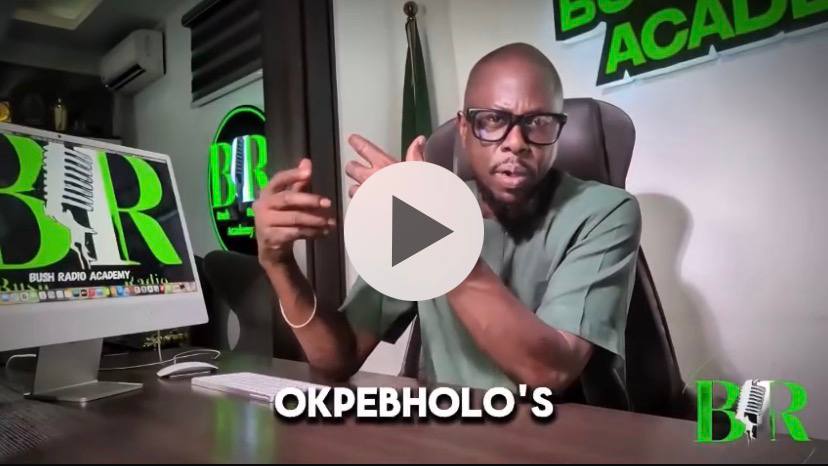
Lasting roads begin with a clear plan for where rainwater will go. With major repairs planned for the dry season and a proposed drainage connection towards the Ogba River, Governor Monday Okpebholo’s administration has outlined an approach that tackles road rehabilitation and stormwater together.
In this episode of Truth Unveiled, we examine the planning behind that approach—and what its delivery could mean for homes, businesses and everyday movement across Benin’s GRA.
Watch the full podcast.
-

 latest1 year ago
“Social Media Erupts As Jim Iyke Declares Rita Dominic Nollywood’s Most Beautiful”
-
 latest3 years ago
Edo Political Showdown: Oshiomhole Appears At Presidential Villa As Tinubu Hands APC Gubernatorial Flag To Okpebholo (Photos & Video)
-
 entertainment3 years ago
Love Knows No Age American Woman Defends Marriage To Young Nigerian Man “I’m Not 70”
-
 latest3 years ago
Olumide Akpata Strikes Again: Drops Killer Track, Sends Edo State Into Frenzy!(Video)
-
 Politics3 years ago
Nigerians React As Pastor Adeboye Foresees Passing Away On A Sunday After Enjoying A Satisfying Meal Of Pounded Yam
-
 latest2 years ago
FG Identifies 31 States At Risk Of Heavy Flooding In 2024: See Full List
-
 Politics3 years ago
BREAKING: Inspector-General Of Police Summons Top Police Commanders For Crucial-Security Challenges
-
 latest3 years ago
5 NYSC Corpers Perish In Fatal Road Accident Returning From Camp