
latest
Governor Adeleke Suspends Osun College Of Education Provost Amidst Financial Impropriety Allegations


Governor Adeleke Suspends Osun College Of Education Provost Amidst Financial Impropriety Allegations....KINDLY READ THE FULL STORY HERE▶
In a recent development, Governor Ademola Adeleke of Osun State has approved the immediate suspension of Prof Jimoh Atanda Afolabi, the Provost of Osun State College of Education, Ila-Orangun….CONTINUE READING
The decision, based on the interim report of an Investigation Panel led by the Chief of Staff to the state governor, Kazeem Akinleye, cites allegations of financial impropriety, concealment of official information, and failure to update the Governing Council on crucial matters within the college.
The Governor, through his spokesperson Olawale Rasheed, released a statement on Friday, announcing the suspension and endorsing the committee’s findings. Notably, the committee recommended the continuation of Dr. Peter Babalola as the Chairman of the Governing Council, stating that there is no proven case of abuse of power or financial wrongdoing against him.
The statement refuted the earlier accusation of a 200 million Naira fraud against Dr. Babalola, citing the lack of substantiated evidence or transaction details. The committee revealed that the cash advance of three million Naira to the council chairman adhered to the college’s financial regulations, supported by verified documentation.
Regarding the suspended Provost, Prof Afolabi, the committee reviewed three previous reports of financial malfeasance, abuse of power, and corruption allegations against him dating back to past administrations. After an exhaustive review, including investigations by the State House of Assembly, the committee recommended Afolabi’s immediate suspension, a decision subsequently endorsed by Governor Adeleke.
The statement concluded by mentioning that the committee would submit its final report at a later date. The controversy surrounding the College Governing Council initiated in January when Chairman Peter Babalola suspended Prof Afolabi for financial misappropriation. In an effort to address the escalating crisis, the state government established a three-man panel of inquiry, which later reinstated Prof Afolabi pending the panel’s investigation outcomes.
In a recent development, Governor Ademola Adeleke of Osun State has approved the immediate suspension of Prof Jimoh Atanda Afolabi, the Provost of Osun State College of Education, Ila-Orangun. The decision, based on the interim report of an Investigation Panel led by the Chief of Staff to the state governor, Kazeem Akinleye, cites allegations of financial impropriety, concealment of official information, and failure to update the Governing Council on crucial matters within the college.
The Governor, through his spokesperson Olawale Rasheed, released a statement on Friday, announcing the suspension and endorsing the committee’s findings. Notably, the committee recommended the continuation of Dr. Peter Babalola as the Chairman of the Governing Council, stating that there is no proven case of abuse of power or financial wrongdoing against him.
The statement refuted the earlier accusation of a 200 million Naira fraud against Dr. Babalola, citing the lack of substantiated evidence or transaction details. The committee revealed that the cash advance of three million Naira to the council chairman adhered to the college’s financial regulations, supported by verified documentation.
Regarding the suspended Provost, Prof Afolabi, the committee reviewed three previous reports of financial malfeasance, abuse of power, and corruption allegations against him dating back to past administrations. After an exhaustive review, including investigations by the State House of Assembly, the committee recommended Afolabi’s immediate suspension, a decision subsequently endorsed by Governor Adeleke.
The statement concluded by mentioning that the committee would submit its final report at a later date. The controversy surrounding the College Governing Council initiated in January when Chairman Peter Babalola suspended Prof Afolabi for financial misappropriation. In an effort to address the escalating crisis, the state government established a three-man panel of inquiry, which later reinstated Prof Afolabi pending the panel’s investigation outcomes.


The Nigeria Labour Congress (NLC) has dismissed reports claiming it negotiated the ₦40,000 consequential adjustment approved for federal workers following the implementation of the ₦70,000 national minimum wage.....KINDLY READ THE FULL STORY HERE▶
The labour organisation clarified that negotiations for consequential salary adjustments were handled exclusively by public sector unions, not the NLC.
In a statement issued on Sunday and signed by its Acting General Secretary, Comrade Benson Upah, the Congress described claims linking it to the ₦40,000 adjustment as false and misleading.
It accused unnamed individuals of deliberately misrepresenting Nigeria’s collective bargaining structure to mislead workers and create divisions within the labour movement.
The NLC explained that its role during the 2024 minimum wage negotiations was limited to determining the national minimum wage, which serves as the basic salary threshold below which no worker should be paid.
It stressed that consequential adjustments, which involve reviewing existing salary structures to accommodate a new minimum wage, are negotiated separately by unions in their respective sectors.
“For the purpose of clarity, we state that the national minimum wage is set through a tripartite process involving the labour movement, the government, and employers’ representatives.
“The NLC’s mandate at this stage is clear and unambiguous: to negotiate the national minimum wage; the primary and basic floor below which no worker should be paid,” the statement partly read.
The Congress further explained that the Joint Public Service Negotiating Council, comprising government representatives and about eight trade unions, handled discussions with the Federal Government on implementing the new minimum wage and consequential adjustments.
It added that similar arrangements apply at the state level, where negotiating councils engage state governments, while industrial unions negotiate with employers’ associations on wage adjustments in the private sector.
Citing the food and beverage industry as an example, the NLC said the Association of Food, Beverage and Tobacco Employers negotiated with the National Union of Food, Beverages and Tobacco Employees on how the new minimum wage would be implemented within the sector.
The labour centre maintained that although it represents workers in both the public and private sectors, this does not make it responsible for negotiating consequential adjustments on behalf of individual unions.
“The NLC represents both the private and public sectors. However, it is critically important to understand that the NLC does not sit at the table to negotiate consequential adjustments in the various sectors.
“The leadership of the unions in these sectors bears sole responsibility for the outcomes of consequential adjustments in their respective sectors,” it stated.
Addressing the ₦40,000 adjustment granted to federal workers, the Congress insisted that the negotiations were led by public sector union leaders.
“Therefore, the claim that the NLC was responsible for negotiating the N40,000 across-the-board addition as consequential adjustment for federal workers is not only false but is a deliberate distortion of the collective bargaining framework in Nigeria.
“The N40,000 outcome was the sole responsibility of the leadership of the unions in the public sector,” the statement added.
The NLC also accused some individuals of attempting to shift responsibility for the adjustment to create confusion within the labour movement, particularly as preparations begin for another round of national minimum wage negotiations.
It insisted that it had never negotiated consequential adjustments with either the government or organised private sector employers.
“Throughout the history of the national minimum wage setting exercise, the leadership of the Nigeria Labour Congress (NLC) has never sat down to negotiate consequential adjustment with neither the government nor the organised private sector employers,” it said.
The Congress warned that attempts to blame it for the ₦40,000 adjustment could weaken workers’ unity at a critical period.
It said such actions were aimed at shifting responsibility and creating divisions as discussions towards a new national minimum wage gather momentum.
New Minimum Wage
The NLC pledged to push for a new national minimum wage that reflects prevailing economic conditions and brings workers closer to earning a living wage.
It urged workers and members of the public to hold the relevant institutions accountable for their respective responsibilities in the negotiation process.
“The new national minimum wage is on the verge of being negotiated. This is a critical moment for Nigerian workers and the masses to take necessary steps to hold specific institutions accountable for their specific expectations.
“The NLC will do its best to ensure that the outcome of this forthcoming exercise continues to serve Nigerian workers and masses and approximates a living wage,” the statement added.
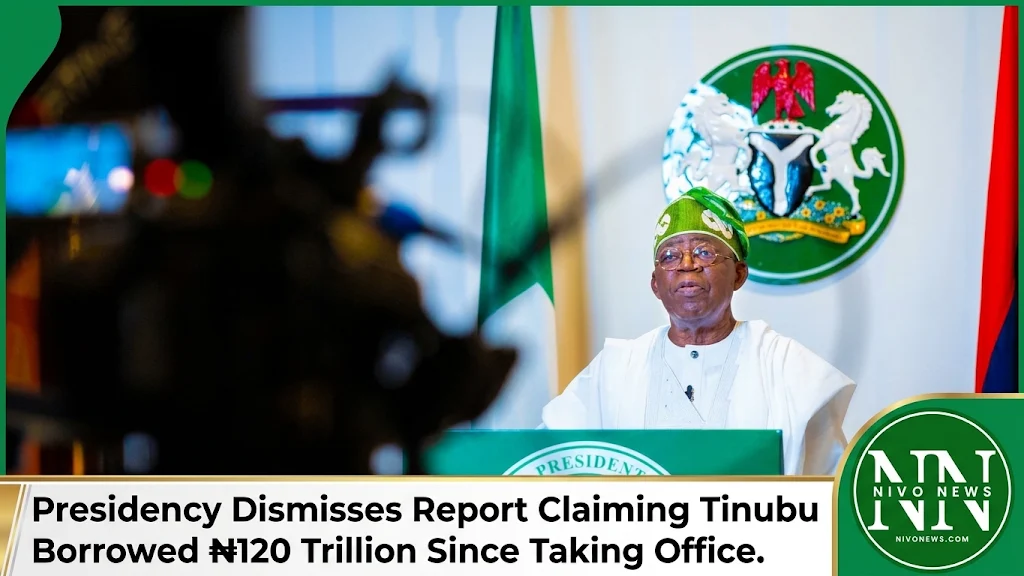
The Presidency has rejected claims that President Bola Tinubu borrowed ₦120 trillion within three years of taking office, describing the figures circulating on social media as misleading.....KINDLY READ THE FULL STORY HERE▶
The clarification was made by the President’s Special Assistant on Social Media, Dada Olusegun, in a statement posted on X on Sunday, November 8. He accused opposition groups of spreading propaganda about the administration’s borrowing record.
A viral graphic had alleged that 16 Nigerian leaders borrowed a combined ₦46 trillion over 63 years, while Tinubu’s government accumulated ₦120 trillion in loans within just three years, despite removing the petrol subsidy.
However, Olusegun argued that the comparison failed to consider previously unrecognised government liabilities and the impact of changes in the exchange rate.
He explained that Nigeria’s public debt of ₦46 trillion at the end of 2022 did not include ₦22.7 trillion in Central Bank of Nigeria (CBN) Ways and Means advances, which the government officially recognised in May 2023.
He also pointed out that earlier debt calculations converted Nigeria’s foreign obligations using an exchange rate of ₦448 to the dollar, even though the parallel market rate had exceeded ₦700 at the time.
According to him, the unification of the exchange rate in June 2023 increased the naira value of existing dollar-denominated debt by ₦13.4 trillion on paper. He stressed that this increase did not result from the government obtaining additional dollar loans.
Olusegun further stated that Nigeria’s public debt increased from $113.4 billion in June 2023 to $120.9 billion in June 2026, representing a rise of $7.5 billion.
Defending the removal of the petrol subsidy, he said the policy had resulted in higher monthly allocations from the Federation Account Allocation Committee (FAAC) to state and local governments.
He noted that the allocations increased from ₦656 billion in April 2023 to ₦2.4 trillion by September 2026.
Meanwhile, figures from the Debt Management Office (DMO) showed that Nigeria’s public debt rose from approximately ₦87.38 trillion in June 2023 to ₦166.79 trillion by June 2026.
A significant portion of the increase in naira terms was attributed to exchange rate adjustments and the securitisation of inherited Ways and Means advances.
The Presidency’s response comes amid renewed debate over the country’s borrowing plans following Tinubu’s request for Senate approval of a $7.7 billion external loan to partly finance the 2026 budget deficit.
Senate President Godswill Akpabio read the request during Wednesday’s plenary. The proposed facility is equivalent to approximately ₦10.79 trillion, based on the budget exchange rate of ₦1,400 to the dollar.
The latest proposal replaced an earlier borrowing request of $20.52 billion and €1.045 billion, which the President had submitted to the National Assembly a week earlier.
Opposition parties, including the Nigeria Democratic Congress (NDC), have criticised the administration’s borrowing plans, warning that the country’s growing debt burden could have serious consequences for future generations.
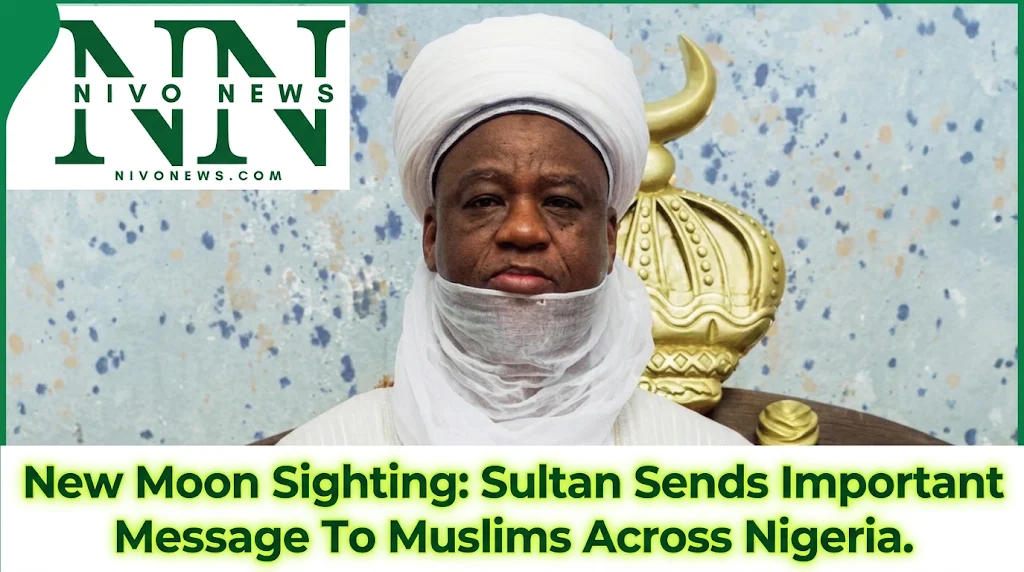
The Sultan of Sokoto and President-General of the Nigeria Supreme Council for Islamic Affairs (NSCIA), Muhammad Sa’ad Abubakar, has called on Muslims across Nigeria to begin searching for the new moon of Jumada Assaniya 1448 AH on Monday, November 9, 2026.....KINDLY READ THE FULL STORY HERE▶
The directive was contained in a statement issued on Sunday by the Sultanate Council of Sokoto and signed by the Wazirin Sokoto, Sambo Wali Junaidu, who also chairs the council’s Advisory Committee on Religious Affairs.
According to the statement, Monday, November 9, corresponds to the 29th day of Jumada al-Ula 1448 AH, making it the designated day for sighting the crescent moon.
Muslims who sight the new moon have been instructed to report their observations to the nearest district or village head. The reports will then be forwarded to the Sultan to enable him to take the necessary action.
The council also urged Muslims to seek Allah’s guidance and assistance in carrying out the religious responsibility.
The statement read: “Muslims are therefore requested to start looking for the new moon of Jumada Assaniya 1448 AH on Monday and report its sighting to the nearest District or Village Head for onward communication to His Eminence, Alhaji Muhammad Sa’ad Abubakar CFR, the Sultan of Sokoto and President General, Nigeria Supreme Council for Islamic Affairs (NSCIA).
“May Allah (SWT) help us in the discharge of this religious duty, amen.”
Jumada Assaniya, also known as Jumada al-Thani or Jumada al-Akhirah, is the sixth month of the Islamic lunar calendar.
-

 latest1 year ago
“Social Media Erupts As Jim Iyke Declares Rita Dominic Nollywood’s Most Beautiful”
-
 latest3 years ago
Edo Political Showdown: Oshiomhole Appears At Presidential Villa As Tinubu Hands APC Gubernatorial Flag To Okpebholo (Photos & Video)
-
 entertainment3 years ago
Love Knows No Age American Woman Defends Marriage To Young Nigerian Man “I’m Not 70”
-
 latest3 years ago
Olumide Akpata Strikes Again: Drops Killer Track, Sends Edo State Into Frenzy!(Video)
-
 Politics3 years ago
Nigerians React As Pastor Adeboye Foresees Passing Away On A Sunday After Enjoying A Satisfying Meal Of Pounded Yam
-
 latest3 years ago
FG Identifies 31 States At Risk Of Heavy Flooding In 2024: See Full List
-
 Politics3 years ago
BREAKING: Inspector-General Of Police Summons Top Police Commanders For Crucial-Security Challenges
-
 latest3 years ago
5 NYSC Corpers Perish In Fatal Road Accident Returning From Camp