
Economy
Justice On Financial Crisis: Federal Government Acknowledges Salary Payment Struggles

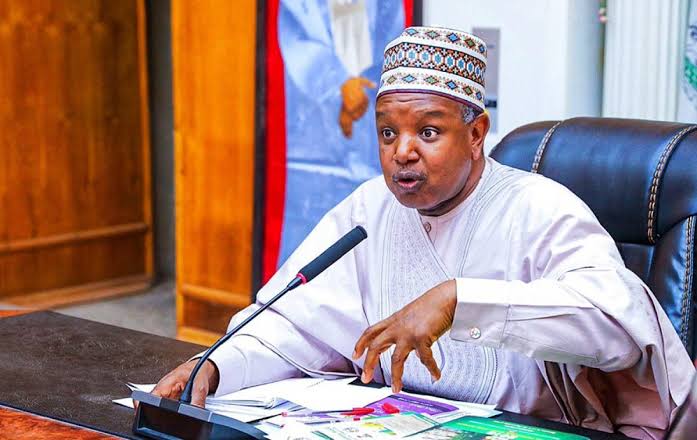
Justice On Financial Crisis: Federal Government Acknowledges Salary Payment Struggles....KINDLY READ THE FULL STORY HERE▶

The Federal Government has officially declared that it is currently facing substantial challenges and a significant revenue deficit, exacerbated by a rapidly growing population.
The Minister of Budget and National Planning, Atiku Bagudu, has disclosed the government’s difficulties in meeting salary obligations. He emphasized the need for non-governmental organizations to play a supportive role in bridging the gaps that the government is currently unable to cover.
Speaking in Abuja, the Minister, represented by Dr. Sampson Ebimaro, the Director of International Cooperation within the ministry, expressed deep concern over the fast-paced increase in Nigeria’s population, accompanied by a surge in unemployment, all set against a backdrop of high inflation.
“The government is currently confronting substantial challenges, especially in the financial arena. The country’s coffers are running dry, with the government struggling to meet its salary obligations,” stated the minister. He also pointed out the slow pace of economic growth and the significant increase in population, which has led to a surge in unemployment amidst high inflation.
Dr. Sarah Alade, a former acting governor of the Central Bank of Nigeria and Special Adviser to former President Muhammadu Buhari on Finance and Economy, emphasized the importance of involving Non-State Actors (NSAs) to achieve the federal government’s goal of lifting millions of Nigerians out of poverty. She urged the government to foster collaboration with NSAs to promote economic development.


According to Nivo News, the World Bank has projected that Nigeria’s economy will grow by 4.4 percent in 2026 and 2027, driven by new tax legislation, prudent monetary policies, and ongoing economic reforms. The announcement was made in the bank’s January 2026 Global Economic Prospects report, which described the anticipated growth rate as the fastest for Nigeria in over a decade.....KINDLY READ THE FULL STORY HERE▶
This latest projection represents an upgrade from the World Bank’s previous forecast of 3.7 percent published in June 2025. The bank highlighted that reforms in the tax system, combined with continued monetary prudence, are expected to stimulate economic activity, improve investor confidence, and reduce inflation. It also noted that increased oil production is likely to offset lower global oil prices, boosting fiscal revenue and strengthening Nigeria’s external balance.
The projection comes against the backdrop of Nigeria’s Gross Domestic Product (GDP) growth of 3.98 percent year-on-year in real terms during the third quarter of 2025, as reported by the National Bureau of Statistics.

Nigeria’s headline inflation rate eased to 14.45 per cent year on year in November 2025, according to the latest Consumer Price Index (CPI) report released by the National Bureau of Statistics (NBS). The report showed that while consumer prices continued to rise on a monthly basis, annual inflation moderated significantly under the revised base year.....KINDLY READ THE FULL STORY HERE▶
The CPI increased to 130.5 points in November from 128.9 points in October, marking a 1.6-point month-on-month rise. Despite this, the headline inflation rate declined from 16.05 per cent recorded in October. The NBS highlighted that the November 2025 figure represents a 1.6 percentage point decrease compared with the previous month.
Monthly inflation, however, rose to 1.22 per cent in November from 0.93 per cent in October, indicating that average prices increased at a faster pace during the month despite the moderation in annual inflation. Headline inflation for November 2025 was 20.15 percentage points lower than the 34.60 per cent recorded in November 2024, reflecting the impact of the rebasing exercise that reset the base year to 2024 from 2009.
Over the twelve months ending November 2025, the average CPI increased by 20.41 per cent, down sharply from 32.77 per cent in the corresponding period of 2024. Food and non-alcoholic beverages remained the largest contributor to annual headline inflation at 5.78 percentage points, followed by restaurants and accommodation services at 1.87 percentage points, and transport at 1.54 percentage points. Housing, water, electricity, gas and other fuels added 1.22 percentage points, while education and health contributed 0.90 and 0.88 percentage points, respectively. On a month-on-month basis, food and non-alcoholic beverages drove price increases with a contribution of 0.49 percentage points.
Urban inflation declined sharply to 13.61 per cent year on year in November, down 23.49 percentage points from November 2024, while rural inflation remained higher at 15.15 per cent but fell 17.12 percentage points from the previous year. Month-on-month, urban inflation slowed to 0.95 per cent, while rural inflation accelerated to 1.88 per cent.
Food inflation moderated annually to 11.08 per cent in November 2025 from 39.93 per cent in November 2024. Monthly food inflation rose to 1.13 per cent, driven by price increases in items such as dried tomatoes, cassava tubers, ground pepper, eggs, crayfish, egusi, oxtail, and fresh onions. Core inflation, which excludes volatile agricultural and energy prices, stood at 18.04 per cent year on year, down from 28.75 per cent in November 2024.
State-level data showed Rivers recorded the highest year-on-year inflation at 17.78 per cent, followed by Ogun at 17.65 per cent and Ekiti at 16.77 per cent. Plateau had the lowest at 9.13 per cent, alongside Kebbi at 10.32 per cent and Katsina at 10.60 per cent. The NBS cautioned that interstate comparisons should be interpreted carefully due to differing consumption patterns and CPI weights across states.

The Nigerian National Petroleum Company Limited (NNPCL) has set a crude oil production target of more than two million barrels per day for 2026, citing strong collaboration with pipeline host communities as a key factor in sustaining increased output.....KINDLY READ THE FULL STORY HERE▶
Akponime Omojevwhe, Head of Field Operations, Eastern Corridor, Project Monitoring Office (PMO), disclosed the projection during a monthly stakeholders’ meeting with host communities along the Trans Niger Pipeline in Port Harcourt. The meeting was organized by Pipeline Infrastructure Nigeria Limited (PINL).
Omojevwhe revealed that the 2026 national production budget is pegged at 2.80 million barrels per day (mbpd), with a starting benchmark of 1.84 mbpd and a targeted achievable output of 2.06 mbpd. He affirmed that the Trans Niger Pipeline is currently operating efficiently, attributing its success to the active cooperation between local communities, stakeholders, and PINL.
He emphasized that community participation is critical to pipeline protection, stating, “No private security structure can succeed without grassroots involvement. The communities are a vital part of this job. Their continued support ensures uninterrupted flow along the pipeline.”
Edi Julius, representing the Minister of State for Petroleum (Oil), Heineken Lokpobiri, lauded the partnership between PINL and the communities, noting that local peace is essential for boosting national oil production. “We are confident that by 2026, Nigeria will exceed two million barrels per day, generating additional revenue and enabling greater support for host communities,” he added.
Dr. Akpos Mezeh, General Manager of Community and Stakeholders’ Relations at PINL, reviewed the year’s progress, highlighting achievements such as strengthened security along the TNP corridor, expanded stakeholder engagement, empowerment programs for women and students, zero incidence of illegal bunkering, and improved community-company trust. He also announced Christmas palliatives for the 215 TNP host communities.
Responding on behalf of the host communities, His Majesty King Philip Osaro Obele urged the federal government to channel more development projects into the region. He praised PINL for its transparency and consistent engagement, emphasizing that ongoing dialogue is essential to maintaining peace along the pipeline.
-

 latest8 months ago
“Social Media Erupts As Jim Iyke Declares Rita Dominic Nollywood’s Most Beautiful”
-
 latest2 years ago
Edo Political Showdown: Oshiomhole Appears At Presidential Villa As Tinubu Hands APC Gubernatorial Flag To Okpebholo (Photos & Video)
-
 entertainment2 years ago
Love Knows No Age American Woman Defends Marriage To Young Nigerian Man “I’m Not 70”
-
 latest2 years ago
Olumide Akpata Strikes Again: Drops Killer Track, Sends Edo State Into Frenzy!(Video)
-
 Politics2 years ago
Nigerians React As Pastor Adeboye Foresees Passing Away On A Sunday After Enjoying A Satisfying Meal Of Pounded Yam
-
 latest2 years ago
FG Identifies 31 States At Risk Of Heavy Flooding In 2024: See Full List
-
 latest2 years ago
5 NYSC Corpers Perish In Fatal Road Accident Returning From Camp
-
 Politics2 years ago
BREAKING: Inspector-General Of Police Summons Top Police Commanders For Crucial-Security Challenges