
latest
Yemi Cardoso Reveals CBN’s Shift Away From Development Financing


Yemi Cardoso Reveals CBN’s Shift Away From Development Financing....KINDLY READ THE FULL STORY HERE▶

The Governor of the Central Bank of Nigeria (CBN), Olayemi Cardoso, has provided insight into the future direction of the country’s apex bank.
In a document obtained from the CBN, Yemi Cardoso, the new CBN governor, explained that the CBN would shift its focus away from direct involvement in development finance interventions.
The document, titled “Preliminary Assessment of the Challenges Facing the CBN,” highlighted the need to distinguish the roles of monetary policy and fiscal intervention and refocus the CBN on its core mandate to support economic growth. This refocusing involves transitioning the CBN from directly financing development projects to a more limited advisory role.
A source within the Central Bank of Nigeria (CBN) emphasized that the CBN had previously been involved in providing funding for various developmental projects, which blurred the lines between its roles in monetary policy and fiscal matters. To address this, the CBN is considering transitioning to a more limited advisory role, providing guidance and expertise to facilitate economic growth.
This advisory role could include offering recommendations on policy measures, regulations, and strategies that support economic development. By limiting its direct involvement in development financing, the CBN aims to avoid potential conflicts between its monetary policy role and fiscal matters, allowing it to focus on its primary mandate of maintaining price stability, promoting financial stability, and ensuring the soundness of the banking system.
The official who is familiar with Cardoso’s agenda added that this shift toward an advisory role will allow the CBN to leverage its expertise and provide valuable insights to policymakers and other stakeholders, helping to make decisions that promote sustainable economic growth.
Yemi Cardoso’s document also outlined specific advisory roles for the CBN, such as acting as a catalyst in the creation of specialized institutions and financial products to support emerging sectors of the economy, facilitating new regulatory frameworks to unlock dormant capital in land and property holdings, and accelerating access to consumer credit and expanding financial inclusion.
The CBN’s advisory role would also extend to de-risking instruments to increase private sector investment in various sectors, including housing, textiles, clothing, food supply chain, healthcare, and educational supplies. Cardoso highlighted the potential for rapid industrialization in these sectors.
Additionally, the CBN would exercise “convening power” to bring key multilateral and international stakeholders into government and private sector initiatives.
Before delving into his plans as the CBN governor, Cardoso identified some challenges facing the apex bank, including issues related to corporate governance, diminished institutional autonomy, the need to refocus the CBN on its core functions, discontinuation of unorthodox monetary policies, unorthodox use of Ways and Means spending, backlog of foreign exchange (FX) demand, lack of clarity in fiscal and monetary relationships, inflation and price stability, access to the FX market and FX price discovery, and the current state of the financial system.
In response to these challenges, the source stated that one of the main tasks for Cardoso is refocusing the CBN on its core functions. Over the years, the CBN has been involved in various activities beyond its primary mandate, including developmental projects and unorthodox monetary policies. Addressing these challenges requires a shift toward evidence-based policymaking, discontinuation of unorthodox measures, and implementing a more transparent and market-driven approach to foreign currency management.
Cardoso’s vision includes implementing fiscal reforms and growth targets to achieve a $1 trillion GDP within eight years. His proposals are based on an analysis of macro-economic indices in countries with large populations and similar characteristics to Nigeria, such as moderate inflation, sizable foreign reserves, and the ability to rebound from economic downturns quickly.
Overall, Cardoso’s vision for the CBN involves a refocused role, evidence-based policymaking, and a transparent approach to foreign currency management to support economic growth and enhance the CBN’s effectiveness in fulfilling its core functions.
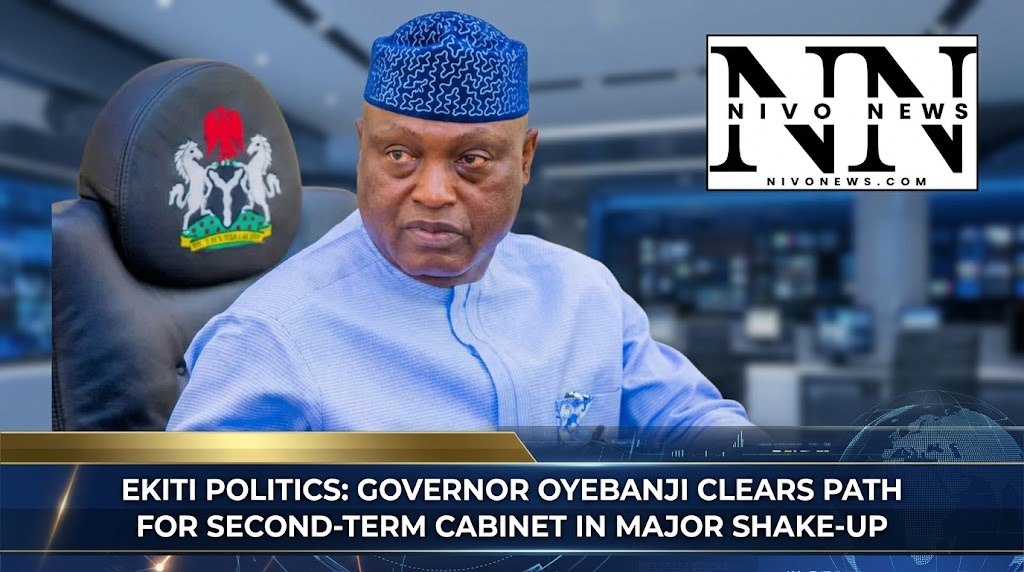
Ekiti State Governor, Biodun Oyebanji, has approved the immediate dissolution of state boards, commissions, and parastatals, alongside terminating the appointments of several political aides.....KINDLY READ THE FULL STORY HERE▶
According to an official statement released on Sunday by the Special Adviser on Media to the Governor, Yinka Oyebode, the termination affects all Special Assistants (SAs), Senior Special Assistants (SSAs), and Technical Assistants (TAs).
The statement clarified that the move is part of a gradual transition as the administration winds down its first term ahead of Governor Oyebanji’s second-term inauguration on October 16, 2026.
Key Exemptions
The governor outlined specific offices, governing bodies, and officials exempted from the directive:
-
Statutory Commissions: Members and chairmen of the State Independent Electoral Commission (SIEC), Civil Service Commission, Judicial Service Commission, and House of Assembly Service Commission remain in office.
-
Tertiary Institutions: The governing councils of all state-owned higher institutions are unaffected.
-
Selected Agency Leadership: The chairmen of the State Universal Basic Education Board (SUBEB), Teaching Service Commission, and Local Government Service Commission retain their positions, though their board members have been relieved of duty.
-
Senior Executive Aides: Directors-General and Technical Advisors to the Governor remain in their respective roles.
Governor Oyebanji commended the outgoing appointees for their dedication, hard work, and valuable contributions toward the progress of Ekiti State during his first tenure.
Former Governor of Cross River State and 2027 Peoples Redemption Party (PRP) presidential candidate, Donald Duke, has stated that petrol in Nigeria can sell between ₦200 and ₦300 per litre without government subsidies if fuel prices are pegged to local production costs rather than international market rates.....KINDLY READ THE FULL STORY HERE▶
Speaking in an interview with Vanguard, Duke explained that true subsidy occurs when a product is bought at a high price and sold to consumers below cost. He argued that since crude oil is Nigeria’s collective resource, domestic fuel pricing should reflect what it costs to extract, refine, and distribute the oil locally.
Key Highlights of Donald Duke’s Strategy:
-
Production Cost vs. Market Price: Duke noted that while crude oil sells internationally for $70 to $80 per barrel, Nigeria’s local production cost does not exceed $40 per barrel. Out of the ~1.7 million barrels produced daily, Nigeria requires only about 300,000 barrels for local consumption.
-
Byproduct Amortization: A single barrel yields seven refined products. Duke proposed that five of those byproducts (such as aviation fuel and kerosene) be sold at commercial international rates, using those revenues to offset the refining costs of petrol and diesel.
-
Domestic Pricing Formula: He advocated supplying petrol and diesel to Nigerians at actual production cost plus a modest 5% to 10% margin to cover distribution.
Under this model, Duke asserted, the federal government could completely eliminate subsidy payments while dramatically reducing pump prices for citizens.

Dr. Echuseh Audu, Executive Secretary of the Taraba State Emergency Management Agency (SEMA), is facing renewed scrutiny following financial disclosures linking her and a related business, Katuka’s Kitchen, to transfers totaling ₦49.44 million.....KINDLY READ THE FULL STORY HERE▶
The developments follow earlier, unproven social media allegations that SEMA diverted over 10,000 bags of rice and 1,000 cartons of groundnut oil intended for internally displaced persons (IDPs). Dr. Audu has strongly denied the diversion claims and voluntarily presented herself to security agencies—including the Police, DSS, NSCDC, and the Ministry of Justice—demanding a full investigation.
Key Financial Inflows & Controversial LPRES Transfer
Financial records obtained by SaharaReporters detail multiple transfers across accounts associated with Audu and Katuka’s Kitchen:
-
World Bank Project Transfer: On October 28, 2025, the Taraba State Livestock Productivity and Resilience Support Project (LPRES) Draw Down Account transferred ₦12,190,726.80 to Katuka’s Kitchen. The same amount was later returned to the LPRES account. Insiders questioned the propriety of a government project conducting business with a public official’s associated entity, though records do not specify if the transaction was a contract payment, reimbursement, or error.
-
Inflows Breakdown (Totaling ₦49.44 Million):
-
₦15M: Transferred from an account under Audu Echuseh Echuseh at UBA (May 10, 2024).
-
₦7M: Transferred from Katuka’s Kitchen’s Fidelity Bank account (August 16, 2024).
-
₦5.25M: Received from Sunday Stephen via Globus Bank (January 30, 2026).
-
₦5M: Received from Callistus Obiejezie (February 25, 2026).
-
₦5M: Transferred from a UBA account under Audu Echuseh (Date unspecified).
-
₦44 Million Hospital Payments
The records also highlight three transactions totaling ₦44 million paid to GTBank accounts belonging to Nizamiye Hospital in Abuja (₦15M on Feb 20, 2026; ₦14M on Feb 26, 2026; and an undated ₦15M payment). Sources close to Audu clarified that these funds were utilized to cover medical expenses for a young girl who subsequently passed away.
Questions Over Business Ownership & Corporate Filings
While sources close to the SEMA Chief claim she formally resigned her role with Katuka’s Kitchen at the Corporate Affairs Commission (CAC), reports indicate her Bank Verification Number (BVN) remains tied to the business’s active accounts across Access Bank, Globus Bank, and Fidelity Bank.
SEMA Maintains Stance on Integrity
TSEMA reiterated its commitment to transparency, noting that over 50,000 emergency victims have benefited from state relief distribution. Dr. Audu had not responded to requests for comment at the time of publication.
-

 latest1 year ago
“Social Media Erupts As Jim Iyke Declares Rita Dominic Nollywood’s Most Beautiful”
-
 latest3 years ago
Edo Political Showdown: Oshiomhole Appears At Presidential Villa As Tinubu Hands APC Gubernatorial Flag To Okpebholo (Photos & Video)
-
 entertainment3 years ago
Love Knows No Age American Woman Defends Marriage To Young Nigerian Man “I’m Not 70”
-
 latest3 years ago
Olumide Akpata Strikes Again: Drops Killer Track, Sends Edo State Into Frenzy!(Video)
-
 Politics3 years ago
Nigerians React As Pastor Adeboye Foresees Passing Away On A Sunday After Enjoying A Satisfying Meal Of Pounded Yam
-
 latest2 years ago
FG Identifies 31 States At Risk Of Heavy Flooding In 2024: See Full List
-
 Politics3 years ago
BREAKING: Inspector-General Of Police Summons Top Police Commanders For Crucial-Security Challenges
-
 latest3 years ago
5 NYSC Corpers Perish In Fatal Road Accident Returning From Camp