
latest
CBN Act Grants President Authority To Remove Deputy Governors


CBN Act Grants President Authority To Remove Deputy Governors....KINDLY READ THE FULL STORY HERE▶

In the midst of the unfolding developments regarding the resignation of Godwin Emefiele, the Governor of the Central Bank, recent scrutiny of the CBN Act has revealed that the President possesses the unilateral authority to remove deputy governors. The President’s power to dismiss the Central Bank Governor, on the other hand, requires a two-thirds majority approval from the Senate, a requirement that does not extend to deputy governors.
Read Also A Journey Of Purpose: Sharing My Chevening Story Of Impact And Hope
Section 11, subsection 2f of the CBN Act explicitly grants the President the authority to remove any deputy governor without the need for consultation with the National Assembly. In contrast, the Act stipulates that the removal of the Governor must be supported by a two-thirds majority vote in the Senate, placing the fate of deputy governors primarily in the hands of the President.
President Tinubu has recently announced a new set of nominees for deputy governors, including Mrs. Emem Nnana Usoro, Mr. Muhammad Sani Abdullahi Dattijo, Mr. Philip Ikeazor, and Dr. Bala M. Bello. These nominees await ratification from the Senate and are intended to replace the outgoing deputy governors, namely Kingsley Obiora, Aishah Ahmad, Ade Shonubi, and Edward L. Adamu.
Despite these presidential nominations, the current deputy governors have not tendered their resignations as of September 16th. Sources close to the deputy governors have indicated that no formal resignations have been submitted. According to these sources, some of the deputy governors’ tenures were recently extended by the National Assembly, and therefore, they are still legally in office, having neither been dismissed by the President nor the National Assembly.
The situation surrounding the deputy governors is further complicated by the National Assembly’s recent extension of the tenure of some of them. Last December, the Senate approved second five-year terms for Aisha Ahmad and Edward Adamu. Dr. Kingsley Obiora, who was appointed in March 2020, is in the fourth year of his term, while Ade Shonubi’s term is set to expire in October.
Legal experts have weighed in on this matter, highlighting that the CBN Act allows both the Governor and Deputy Governors of the Central Bank to submit their resignations at least three months in advance, in writing, to the President. The Act also empowers the President to appoint replacements to serve the remaining duration of the term. Notably, while Senate support is required for the removal of the CBN Governor, the same does not apply to the Deputy Governors, allowing the President to dismiss them without Senate approval.
In essence, the law stipulates that the President can remove a Deputy Governor without Senate involvement, but Senate approval is necessary to remove the Governor. The recent nominations for deputy governors are subject to confirmation by the Nigerian Senate, and the fate of the CBN Governor, Godwin Emefiele, remains uncertain, with reports suggesting his resignation and a three-month notice period if accurate.
In summary, the President has the authority to remove Deputy Governors of the Central Bank without Senate confirmation, while the removal of the Governor requires a two-thirds majority vote in the Senate. The recent nominations for these positions are awaiting Senate confirmation, and the situation regarding the current officeholders is complex, with legal and procedural considerations at play.
latest
“YOU SHALL FALL INTO THE PIT!” Natasha Blasts Akpabio With Fire And Fury Over Explosive Leaked Audio!

Senator Natasha Akpoti-Uduaghan (representing Kogi Central) has publicly responded to the controversy surrounding Senate President Godswill Akpabio following the emergence of a leaked audio recording.....KINDLY READ THE FULL STORY HERE▶
According to reports, Akpoti-Uduaghan shared her stance via a Facebook post on Monday, September 21, 2026, where she alleged that Akpabio’s office has been distributing materials to media outlets for publication. Addressing the Senate President directly, she issued a stern warning that actions taken against her will ultimately backfire, writing:
“Dear Godswill Akpabio, Senate President of the Nigerian 10th Assembly… continue. Dear Punch Newspapers, Guardian Nigeria, and others… you may take the envelope and publish whatever Akpabio’s office sends to you. S.P. Akpabio, know that the pits you dig for me, you shall very well fall into.”
Context of the Leaked Audio
-
The Allegations: Her reaction follows fresh claims by U.S.-based activist Sandra Duru (also known as Prof Mgbeke), who published a nine-minute audio clip on social media.
-
The Recording: Duru claimed the audio features a male voice belonging to Akpabio and that he allegedly hired her to campaign against Akpoti-Uduaghan. This marks a shift from her 2025 claims, where she previously alleged that the Kogi senator tried to recruit her against the Senate President.
-
Further Disclosures: Duru indicated that this audio serves as a preview of more upcoming revelations regarding her purported dealings with Akpabio.
latest
BLOCKBUSTER RULING: Appeal Court Flips Script On Magu’s EFCC Tenure In Stunning Legal Reversal!.
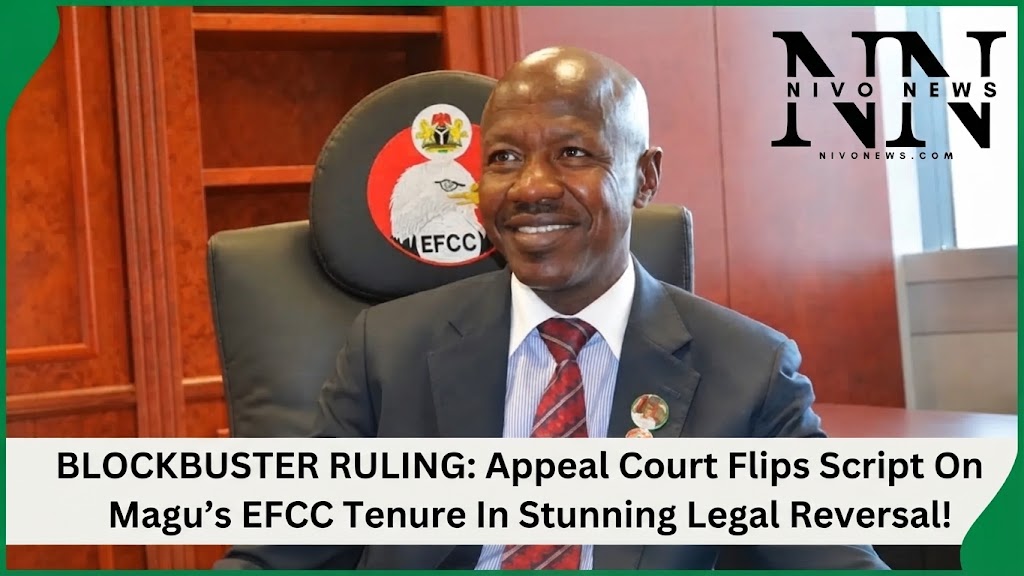
The Court of Appeal in Abuja has set aside a previous Federal High Court ruling that validated Ibrahim Magu’s extended service as the acting Chairman of the Economic and Financial Crimes Commission (EFCC).....KINDLY READ THE FULL STORY HERE▶
The appellate court’s decision follows an appeal by Abuja-based lawyer and activist Johnmary Jideobi. He challenged Magu’s prolonged acting tenure after the Senate twice rejected his nomination for a substantive appointment.
Background of the Case
-
The Origin: Jideobi filed the initial suit in March 2017, arguing that Magu could not occupy the acting role indefinitely following his rejection by the Senate.
-
The 2019 High Court Ruling: Justice Ijeoma Ojukwu dismissed the suit, ruling that the EFCC Establishment Act contained a gap regarding the time limit for an acting chairperson, leaving the duration to presidential discretion.
-
The Appeal: Dissatisfied, Jideobi argued that keeping Magu in office violated statutory limits and that the acting appointment legally terminated once the Senate rejected his nomination.
Subsequent Developments
Magu’s tenure as acting chairman ultimately concluded in July 2020 following his suspension by former President Muhammadu Buhari over misconduct allegations, which Magu denied before an investigative panel.
Following his exit, Mohammed Umar Abba temporarily took over before Abdulrasheed Bawa was appointed as substantive chairman in February 2021. Bawa was later suspended in June 2023 by President Bola Tinubu, leading to the appointment of the current substantive chairman, Ola Olukoyede.

The Joint Admissions and Matriculation Board (JAMB) has announced the dismissal of an employee found guilty of extorting candidates.....KINDLY READ THE FULL STORY HERE▶
In a bulletin released on Monday, September 21, 2026, the examination body stated that the staff member was sanctioned for exploiting unsuspecting candidates. JAMB emphasized that this action is part of broader measures to prevent officials from using their positions for personal gain and to protect the public from exploitation.
The board issued a strong warning to its entire workforce, stating that no employee, regardless of their status, would be shielded from disciplinary action for misconduct that compromises the integrity of the admission and examination process. JAMB reiterated its zero-tolerance policy for fraud, making it clear that both internal and external offenders will face the full consequences of their actions.
-

 latest1 year ago
“Social Media Erupts As Jim Iyke Declares Rita Dominic Nollywood’s Most Beautiful”
-
 latest3 years ago
Edo Political Showdown: Oshiomhole Appears At Presidential Villa As Tinubu Hands APC Gubernatorial Flag To Okpebholo (Photos & Video)
-
 entertainment2 years ago
Love Knows No Age American Woman Defends Marriage To Young Nigerian Man “I’m Not 70”
-
 latest3 years ago
Olumide Akpata Strikes Again: Drops Killer Track, Sends Edo State Into Frenzy!(Video)
-
 Politics3 years ago
Nigerians React As Pastor Adeboye Foresees Passing Away On A Sunday After Enjoying A Satisfying Meal Of Pounded Yam
-
 latest2 years ago
FG Identifies 31 States At Risk Of Heavy Flooding In 2024: See Full List
-
 Politics3 years ago
BREAKING: Inspector-General Of Police Summons Top Police Commanders For Crucial-Security Challenges
-
 latest3 years ago
5 NYSC Corpers Perish In Fatal Road Accident Returning From Camp