
latest
The Ultimate Cost of Power: Obasanjo Drops Bombshell On How Petrol Price Skyrocketed From ₦20 To Over ₦1,000.

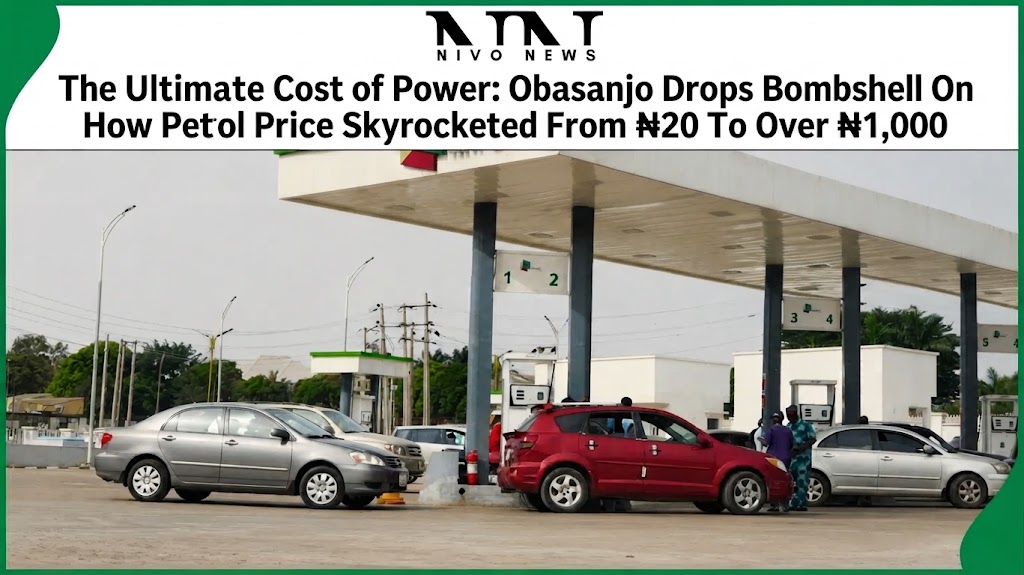
Since the dawn of the Fourth Republic in 1999, the price of Premium Motor Spirit, commonly known as petrol, has experienced a seismic shift in Nigeria. At the start of this democratic era, a litre cost roughly ₦20; over two decades later, that same litre has surged past the ₦1,000 mark, even eclipsing ₦1,500 in early 2026 before settling back slightly.....KINDLY READ THE FULL STORY HERE▶
Petrol pricing remains arguably the most politically charged economic issue in the country due to its immediate, ripple effect on transportation, food costs, electricity generation, and the overall cost of living. While successive governments have attempted to manage these costs through subsidy regimes and regulation, the market was radically altered in May 2023 when President Bola Tinubu removed the petrol subsidy. Unlike the previous era of uniform, government-mandated pump prices, Nigeria now operates under a market-driven system where prices fluctuate based on the supplier, the filling station, and geographic location.
Below is a chronological breakdown of how the price of a litre of petrol has evolved in Nigeria from 1999 to 2026.
The Early Democratic Years (1999–2007)
1999: The ₦20 Baseline Nigeria entered its Fourth Republic with petrol retailing for approximately ₦20 per litre. The outgoing military administration of General Abdulsalami Abubakar had initially hiked the price from ₦11 to ₦25 in December 1998, but fierce public resistance forced a downward review to ₦20 in January 1999. This was the price point inherited by President Olusegun Obasanjo when he took office on May 29, 1999.
2000: Protests and the ₦22 Benchmark The new century saw the first major conflict over fuel pricing. On June 1, 2000, the Obasanjo administration increased the price from ₦20 to ₦30 per litre. The move sparked immediate, widespread protests led by organized labor. After intense negotiations, the government bowed to pressure, reducing the price first to ₦25 and eventually settling on ₦22 per litre, which became the new benchmark.
2001: A Year of Stability Following the adjustments of the previous year, 2001 was marked by stability. The price held steady at approximately ₦22 per litre for almost the entire year.
2002: Incremental Hikes As part of a gradual strategy to reduce the enormous financial burden of subsidies, the Federal Government raised the petrol price from ₦22 to ₦26 per litre.
2003: Breaking the ₦40 Barrier Shortly after President Obasanjo began his second term, another upward review took the price of petrol from ₦26 to a range of ₦40–₦42 per litre. Historical accounts vary slightly on the precise benchmark, reflecting staggered adjustments and regional differences during this period.
2004: The ₦65 Milestone Government implemented further significant increases in 2004. The price first jumped to approximately ₦50 per litre before a subsequent adjustment pushed it to ₦65 per litre. This meant that within just five years of returning to democracy, the official pump price had more than tripled from the initial ₦20 in 1999.
2005–2006: Sustained Pricing Despite inflationary pressures, the official price of petrol held firm at around ₦65 per litre through much of 2005 and 2006. However, during periods of scarcity, actual market prices—particularly at roadside and black-market outlets—were often considerably higher.
2007: Yar’Adua’s First Reversal In a controversial final move just before leaving office in May 2007, the Obasanjo administration increased the price from ₦65 to ₦75 per litre. The decision triggered immediate backlash and protests. Upon assuming office, President Umaru Musa Yar’Adua swiftly reversed the increase, bringing the pump price back to ₦65 per litre. This was noted as the first major downward price review by a civilian administration in the Fourth Republic.
The Long ₦65 Plateau and the End of the Subsidy Illusion (2008–2015)
2008–2011: The Stable Benchmark Throughout the remainder of the Yar’Adua administration and the early years of the Goodluck Jonathan presidency, the official price remained anchored at ₦65 per litre. There were no major upward adjustments during this period. By 2011, however, the immense cost of the subsidy program was becoming unsustainable, and the Jonathan administration began laying the groundwork for a major overhaul of the system, a decision that would ignite the nation.
2012: The “Occupy Nigeria” Shock On New Year’s Day, 2012, the Jonathan administration announced the full removal of the petrol subsidy. The effect on the market was instantaneous and dramatic. The official pump price leaped from ₦65 to approximately ₦141 per litre. This triggered the massive, nationwide “Occupy Nigeria” protests, characterized by strikes and civil unrest. After weeks of intense pressure and negotiation with labor leaders, the government partially restored the subsidy, reducing the official benchmark price to ₦97 per litre.
2013–2014: A New Normal Following the 2012 crisis, the price remained officially fixed at approximately ₦97 per litre for the next two years. While motorists often paid significantly more during intermittent fuel shortages, the regulated pump price saw no major official adjustment during this period.
2015: Jonathan’s Election-Year Reduction With global crude oil prices collapsing, the Jonathan administration announced a downward review in January 2015. Petroleum Resources Minister Diezani Alison-Madueke declared that the price would drop from ₦97 to ₦87 per litre, effective January 19. This ₦87 price was subsequently inherited by President Muhammadu Buhari, who took office on May 29, 2015.
The Buhari Era: From ₦87 to Over ₦500 (2016–2023)
2016: Buhari Raises the Cap In May 2016, facing severe foreign exchange shortages that made it difficult for importers to source products, the Buhari administration announced another major price adjustment. The government increased the price from ₦87 to a maximum cap of approximately ₦145 per litre, signaling another shift towards full deregulation.
2017–2019: Three Years of Relative Calm The ₦145 benchmark remained the official price cap for the next three years. However, this period was not without disruption. Fuel shortages towards the end of 2017 created long queues and fueled black-market sales at exorbitant rates. Aside from these scarcity periods, motorists generally continued to purchase fuel at filling stations within the regulated ₦145 range.
2020: COVID-19 Volatility The global collapse of oil prices during the COVID-19 pandemic forced the Federal Government to make several price adjustments. In March, the price was reduced to approximately ₦125 per litre. Further downward reviews followed, taking the price to roughly ₦121.50–₦123.50. As crude prices began to recover later in the year, the price began to climb. By July, the benchmark had moved to around ₦140.80, followed by subsequent hikes in August and September. By the end of 2020, pump prices generally ranged between ₦160–₦165 per litre, depending on the marketer.
2021: The Subsidy Dilemma Lingers Despite ongoing debates about full deregulation and the staggering financial cost of the subsidy, the government continued to bear the burden. Petrol generally traded in the range of ₦162 to ₦165 per litre at major filling stations throughout the year.
2022: The Gap Widens While the official regulated benchmark remained near ₦165 per litre for most of 2022, persistent fuel scarcity meant that many Nigerians were forced to pay considerably more. The National Bureau of Statistics later reported that the average retail price actually paid by consumers in December 2022 was ₦206.19 per litre, highlighting the growing disparity between the official price and market reality.
Early 2023: The Pre-Removal Spike Even before the formal removal of the subsidy, ongoing fuel scarcity pushed the actual cost to consumers far above the official rate. The NBS recorded a national average retail price of ₦257.12 per litre in January 2023. Official prices at major outlets might have been lower, but supply gaps created substantial price variations across the country. This set the stage for the biggest change in Nigeria’s petrol pricing history in decades.
The Post-Subsidy Era (2023–2026)
May 2023: “Fuel Subsidy is Gone” During his inauguration on May 29, 2023, President Bola Tinubu declared that “fuel subsidy is gone.” The impact on the market was immediate and historic. Before the announcement, the official price at many major stations was between ₦184–₦195 per litre. Within days, NNPC stations adjusted their prices to over ₦500 per litre, with Abuja recording a high of approximately ₦537. This represented one of the single largest price jumps in the nation’s history.
July 2023: Crossing the ₦600 Mark By July, prices were adjusted again. NNPC increased its pump price in Abuja from roughly ₦537 to ₦617 per litre, with prices in Lagos and other cities reflecting similar market-based adjustments. NNPC attributed the hike to the new realities of a deregulated environment. By December 2023, the NBS confirmed the new reality, stating Nigerians paid an average of ₦671.86 per litre, compared to ₦206.19 in December 2022—a year-on-year increase of over 225%.
2024: Breaking the ₦1,000 Barrier Nigeria began 2024 with petrol already three times more expensive than it was before the subsidy removal. The NBS recorded a national average of ₦668.30 per litre in January. Prices continued their upward trajectory, driven by a weakening naira and higher import costs. The average climbed past ₦770 in July and ₦830 in August, followed by significant jumps in September and October. In October, NNPC raised its Lagos price to ₦998 per litre, while Abuja prices crossed the ₦1,000 mark, settling around ₦1,030. By December 2024, the NBS national average hit approximately ₦1,189.12 per litre, marking the first year the national average price remained firmly above ₦1,000.
2025: A New Market Reality The deregulated market saw both increases and decreases in 2025, though the nationwide average generally stayed above ₦1,000 per litre for most of the year. The average stood at approximately ₦1,037 in June, falling to ₦970 by September, before rising to ₦1,061 in November and closing the year at ₦1,048. The annual average for 2025 was approximately ₦1,104. However, competition from the Dangote Refinery began to show its potential, with some MRS stations supplied by Dangote selling petrol for as low as ₦739 per litre in December, drawing long queues. This illustrated the new reality: there is no longer necessarily one nationwide pump price.
Early 2026: Record Highs and a Dangote Ripple According to the NBS, the average retail price was ₦1,034.76 in January 2026, rising slightly to ₦1,051.47 in February. However, international market pressures and supply costs triggered a massive spike in March, sending the national average to approximately ₦1,288.54 per litre. Reuters reported that Nigerian prices had hit record highs despite increased domestic refining capacity. The upward trend accelerated in April, with the NBS recording a national average of approximately ₦1,532.93 per litre, an increase of almost ₦500 per litre from January. Prices peaked nationally in May 2026, hitting an average of ₦1,596.25 per litre.
June–September 2026: Prices Moderate Prices subsequently began to moderate as supply conditions stabilized and domestic refiners adjusted their selling prices. By June, the national average had fallen to roughly ₦1,300 per litre. In early August, the Dangote Refinery reduced its ex-depot price from ₦1,215 to ₦1,165 per litre, fueling further competition. By late August, NNPC stations in Lagos were selling around ₦1,205, while Abuja prices ranged from ₦1,210 to ₦1,300 at major outlets. By the end of August and into September, prices shifted slightly again as Dangote increased its gantry price to ₦1,200 per litre and NNPC outlets in Abuja adjusted their retail price to around ₦1,270 per litre.

Nigeria’s senior women’s basketball team, D’Tigress, has touched down in Berlin, Germany, to finalize preparations for the 2026 FIBA Women’s Basketball World Cup commencing on Friday. Upon their arrival, the five-time African champions were received by Nigeria’s Ambassador to Germany, Ita Enang, alongside other diplomatic officials. This leg follows a rigorous training regimen that included a final camp in Zaragoza, Spain—featuring warm-up matches against Mali and Puerto Rico—following prior training blocks in the United States, China, and Tenerife.....KINDLY READ THE FULL STORY HERE▶
Coached by Rena Wakama, the squad enters the global tournament drawn into Group B, where they will face South Korea on Friday, Hungary on Saturday, and France in their concluding group fixture on Monday. D’Tigress arrives riding strong momentum as the reigning African champions, having defeated Mali 78-64 in the 2025 FIBA Women’s AfroBasket final in Abidjan. Building on their historic quarter-final appearance at the 2024 Paris Olympics—which marked a first for any African basketball team—the squad aims to surpass or match their best-ever World Cup performance of an eighth-place finish achieved in 2018.
latest
Viral Shockwave: Oyo APC Guber Candidate’s Campaign Team Drops Explosive Explanation For Student Sitting On His Lap!.

The campaign organization for Senator Sharafadeen Alli, the All Progressives Congress (APC) governorship candidate in Oyo State, has addressed a viral video showing a student from The Polytechnic, Ibadan, sitting on his lap. In a statement released on Wednesday, the campaign clarified that students from the institution’s Department of Banking and Finance had visited Alli’s Mokola campaign office in Ibadan to invite him to an event and conduct an interview. Because there were not enough chairs to accommodate everyone present, Alli cordially invited one of the students to share his seat.....KINDLY READ THE FULL STORY HERE▶
The footage, which also captured Alli briefly touching the student’s lap, sparked varied reactions and online speculation. Strongly condemning attempts by certain platforms to sexualize the interaction, the campaign team dismissed these claims as misleading and politically motivated. They characterized Alli’s actions as a completely innocent, spontaneous, and fatherly gesture born entirely out of a seating shortage. Expressing disappointment that political desperation would twist a simple meeting with students seeking support into something sordid, the organization urged the public to ignore the false narratives and emphasized Alli’s well-known, supportive rapport with young people.
entertainment
The Ultimate Betrayal: Why Patience Ozokwor Says Protecting Your Child From Hardship Ruins Everything!.

Veteran Nollywood actress Patience Ozokwor has strongly criticized parents who completely insulate their children from labor and adversity, warning that preventing kids from experiencing hardship is the quickest way to ruin their lives. During an interview with media personality Femi Baba, the beloved star—famously known as Mama G—emphasized that parents should not deny their children the valuable lessons of struggle out of a misguided sense of love. Citing her own strict parenting approach, she shared how she once told her son that her house did not belong to him and made him leave to earn his own living, noting that instilling discipline and hard work has ensured her children are doing well today.....KINDLY READ THE FULL STORY HERE▶
In addition to her views on child-rearing, Ozokwor opened up about her personal history, including her early and challenging marriage at the age of 19 when she was ill-prepared for such heavy responsibilities. Speaking during an interview with media personality Isbae U, she characterized those early years as exceptionally difficult, though she noted that her children ultimately brought immense joy and purpose to her life. Acknowledging that life rarely follows a predictable blueprint, she reflected on how individuals can discover profound meaning in formerly painful experiences by shifting their perspective toward the positive elements of their journey. Ozokwor concluded by expressing deep gratitude for her present circumstances, attributing much of her happiness and fulfillment to the enduring support of her children and family.
-

 latest1 year ago
“Social Media Erupts As Jim Iyke Declares Rita Dominic Nollywood’s Most Beautiful”
-
 latest2 years ago
Edo Political Showdown: Oshiomhole Appears At Presidential Villa As Tinubu Hands APC Gubernatorial Flag To Okpebholo (Photos & Video)
-
 entertainment2 years ago
Love Knows No Age American Woman Defends Marriage To Young Nigerian Man “I’m Not 70”
-
 latest2 years ago
Olumide Akpata Strikes Again: Drops Killer Track, Sends Edo State Into Frenzy!(Video)
-
 Politics3 years ago
Nigerians React As Pastor Adeboye Foresees Passing Away On A Sunday After Enjoying A Satisfying Meal Of Pounded Yam
-
 latest2 years ago
FG Identifies 31 States At Risk Of Heavy Flooding In 2024: See Full List
-
 Politics3 years ago
BREAKING: Inspector-General Of Police Summons Top Police Commanders For Crucial-Security Challenges
-
 latest2 years ago
5 NYSC Corpers Perish In Fatal Road Accident Returning From Camp