
latest
“CASH VS. BALLOTS: Do Mega Campaign Budgets Really Guarantee Victory In Nigeria’s High-Stakes 2027 Elections?”.


With the 2027 general elections fast approaching, political momentum is building across Nigeria. Parties and candidates have kicked off aggressive campaigns, but the race is already being defined by two major controversies: astronomical outdoor advertising fees and the ongoing debate over whether massive spending actually wins elections.....KINDLY READ THE FULL STORY HERE▶
The recently concluded governorship election in Osun State has set the tone for 2027. Despite a high-stakes, two-horse race between incumbent Governor Ademola Adeleke (Accord Party) and Bola Oyebamiji (APC)—backed by heavy national mobilization and deep pockets from the APC—money alone didn’t secure the win.
-
The Results: Adeleke emerged victorious with 511,067 votes across 19 local governments, defeating Oyebamiji, who polled 444,815 votes across 11 local governments.
-
The Takeaway: Analysts are questioning whether astronomical campaign spending actually moves the needle, or if factors like incumbency and local popularity carry more weight.
2. Pushback Over Exorbitant Campaign Signage Fees
Political parties across several states are fiercely rejecting newly introduced outdoor advertising rates imposed by state signage agencies ahead of 2027:
-
Abia State: The ADC slammed the agency’s rates—₦200 million for presidential candidates and ₦150 million for governorship hopefuls—warning they violate Electoral Act spending limits and suffocate the opposition. AAC presidential candidate Omoyele Sowore blasted Governor Alex Otti over the directive.
-
Cross River State: CRISSAA defended its tariffs (ranging from ₦150 million for presidential candidates down to ₦5 million for state assembly bids), claiming they are moderate and designed to curb insults and regulate public space fairly.
-
Kogi State: The PDP similarly rejected local government and 2027 campaign signage fees (such as ₦150 million for president and ₦50 million for senate), calling them excessive, undemocratic, and exclusionary.
3. Expert Insight: “More Money Does Not Always Mean More Votes”
Public finance expert and CISD Executive Director, Folahan Johnson, weighed in on the real impact of campaign finances:
-
Efficiency Over Volume: Campaigns should measure success by cost-per-vote rather than total cash splashed. A candidate who spends less to generate higher targeted turnout is far more efficient.
-
Diminishing Returns: Past a certain threshold, extra rallies and ads stop convincing new voters and simply preach to the converted.
-
Separating Spending from Vote-Buying: Johnson cautioned against conflating legal campaign expenditures (logistics, advertising, and rallies) with outright vote-buying at polling units, emphasizing that they are entirely distinct issues.
Former Kaduna State Governor, Nasir El-Rufai, appeared before the Kaduna State High Court on Tuesday as proceedings continued in his alleged fraud trial.Before entering the court premises, El-Rufai was seen exchanging pleasantries with Isa Kudan, the African Democratic Congress (ADC) governorship candidate in Kaduna State.
The former governor is facing a nine-count charge bordering on alleged corruption and other financial offences linked to transactions and decisions made during his tenure from 2015 to 2023.
Tuesday’s proceedings came after El-Rufai’s unsuccessful attempts to secure bail in the Kaduna State case, alongside a separate controversy surrounding a medical report submitted in support of his bail application.
The Court of Appeal had earlier rejected his bail request, following similar decisions by the lower courts.
Justice Darius Khobo had scheduled the latest hearing and directed the Independent Corrupt Practices and Other Related Offences Commission (ICPC), which has custody of the former governor, to produce him in court for the continuation of proceedings.
Meanwhile, the Federal High Court in Abuja has dismissed a suit filed by El-Rufai seeking to prevent the ICPC, the Economic and Financial Crimes Commission (EFCC) and other agencies from freezing his bank accounts or seizing his assets.
Justice Joyce Abdulmalik dismissed the suit on Thursday, ruling that it amounted to an abuse of court process because the former governor had previously filed a similar case before the FCT High Court.
The judge also upheld the respondents’ argument that the court could not be used to stop law enforcement agencies from carrying out their statutory responsibilities.
Justice Abdulmalik further described the suit as speculative and lacking in merit.
She held that the case disclosed no reasonable cause of action against the EFCC, the Department of State Services (DSS) and the Attorney-General of the Federation, subsequently striking out their names from the suit.
El-Rufai had filed the case, marked FHC/ABJ/CS/368/2026, seeking orders restraining the agencies from freezing his bank accounts, seizing his properties or forfeiting his assets pending the determination of the substantive matter.
He also asked the court to declare that the severance benefits he received after completing his tenure as Kaduna State governor between 2015 and 2023 were lawfully earned and could not be classified as proceeds of crime.....KINDLY READ THE FULL STORY HERE▶
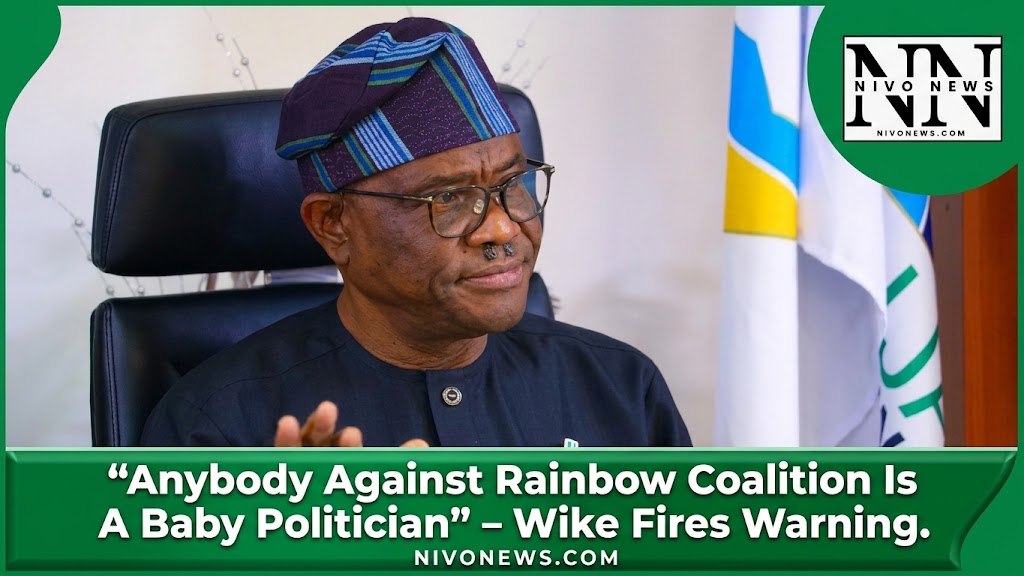
The Minister of the Federal Capital Territory (FCT), Nyesom Wike, has criticised those opposing his Rainbow Coalition, describing them as “baby politicians.”Speaking during a media chat in Abuja on Tuesday, the former Rivers State governor said critics of the coalition failed to understand the importance of political alliances.
Wike also insisted that there would be no confusion over the coalition’s decision to support President Bola Tinubu in the 2027 presidential election.
He cited previous instances in Nigeria where politicians from different parties formed alliances to achieve electoral success.
The FCT minister explained that he had directed his supporters to work for Tinubu’s re-election while also supporting their preferred candidates in the National Assembly elections.
“Anybody who says he does not recognise the importance of Rainbow Coalition is not a politician. Anybody who said that is a baby politician. Is there any conflict? There is no conflict. How does it confuse people?” he asked.
Meanwhile, social media activist Martins Otse, popularly known as VeryDarkMan, has warned Wike against attempting to influence the outcome of the 2027 general elections.
In a video shared on Instagram, Otse maintained that Nigerians could resist any attempt to undermine their votes.
He was reacting to remarks attributed to Wike suggesting that Tinubu would win the presidential election regardless of the voting outcome.
VeryDarkMan interpreted the reported comments as an indication that the election could be manipulated in favour of the incumbent president.....KINDLY READ THE FULL STORY HERE▶
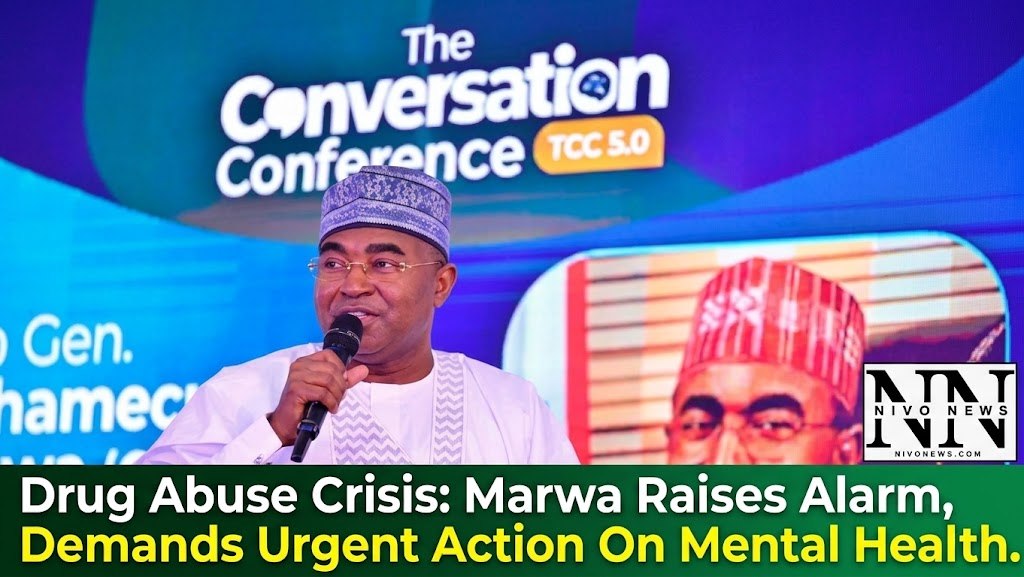
The Chairman and Chief Executive Officer of the National Drug Law Enforcement Agency (NDLEA), Brig. Gen. Mohamed Buba Marwa (rtd.), has called for urgent action to address the link between drug abuse and mental health challenges, warning that both problems often reinforce each other.....KINDLY READ THE FULL STORY HERE▶
Marwa made the statement on Tuesday, October 13, 2026, in Abuja, while chairing the fifth edition of The Conversation Conference (TCC 5.0).
He cautioned that efforts focused solely on addressing the visible effects of drug abuse would fail to tackle the underlying problems contributing to substance use.
“If we only arrest the symptoms, we will keep missing the cause,” he warned.
Marwa, who also chaired the inaugural conference in 2022 and its third edition, described the gathering as one of Nigeria’s major mental health events. He said the conference, held days after World Mental Health Day, provided an opportunity to move beyond awareness campaigns towards practical action.
According to the NDLEA chief, many people receiving treatment for drug abuse at the agency’s rehabilitation centres struggle with unresolved emotional and psychological challenges.
“For too long, we treated mental health as a private burden, hidden behind shame and silence. In my work at the NDLEA, I see the cost of that silence daily.
“Behind many cases of drug abuse is untreated pain: depression nobody noticed, trauma nobody addressed, a young person who found a substance before finding help. Drug use and mental illness feed each other. If we only arrest the symptoms, we will keep missing the cause,” he said.
Marwa Advocates Community-Based Solutions
Addressing the conference theme of strategic investments, partnerships and community-led action, Marwa said mental wellbeing would remain difficult to achieve in communities where poverty and hopelessness push people towards harmful behaviour.
He cited the NDLEA’s intervention in three pilot communities in Ondo State, where residents who previously depended on illicit cultivation were supported in developing lawful and sustainable sources of income.
According to him, the initiative demonstrated how economic opportunities and community participation could help reduce vulnerability and strengthen social stability.
“Your theme speaks of strategic investments, partnerships and community-led action. At the NDLEA, these are not abstract ideas. They are things we have done. Mental wellbeing cannot thrive where hopelessness and poverty drive people into harm,” he said.
Marwa explained that the agency worked alongside residents to establish legitimate livelihoods, enabling families to earn a decent income without relying on illicit cultivation.
“When people have hope, income and a stake in their future, stress eases, families stabilise, and communities grow resilient. These were solutions designed with communities, not imposed on them,” he added.
He disclosed that the NDLEA planned to expand the initiative to other parts of the country and called on development partners and other stakeholders to support the effort.
The agency chief also highlighted the War Against Drug Abuse (WADA) campaign, which educates young people in schools, tertiary institutions and communities about the dangers of substance abuse.
He further pointed to the NDLEA’s toll-free helpline, available around the clock, as a channel through which individuals and families can seek assistance without paying for the service.
Marwa said the helpline provides support to people facing difficult circumstances, including teenagers in distress and parents worried about their children.
Over 53,000 People Treated At NDLEA Rehabilitation Centres
Marwa revealed that more than 53,843 people had received care at the NDLEA’s 31 rehabilitation facilities across Nigeria over the past five years.
“Behind that number are fathers returned to their families and young people returned to school and work,” he said.
He stressed that mental healthcare should receive greater attention in public health budgets, arguing that investment in prevention, trained professionals and accessible treatment would yield benefits for productivity, public safety and family stability.
The NDLEA chairman called for increased recruitment of psychiatrists, psychologists, counsellors and community health workers. He also advocated integrating mental health services into primary healthcare facilities to ensure people could access support without travelling long distances.
He maintained that mental healthcare financing must be fair and accessible to all income groups.
“Care that only the well-off can afford is not a system, it is a privilege,” he said.
Marwa Urges Greater Protection For Women And Children
Commending the conference’s focus on women and children, Marwa said vulnerable groups, including survivors of violence, displaced mothers, girls without adequate support, persons living with disabilities and families affected by conflict, were often overlooked.
He noted that the NDLEA’s experience showed that recovery was more sustainable when support extended beyond individuals to include their mothers, children and other household members.
Marwa also emphasised that tackling drug abuse and mental health challenges required cooperation among multiple sectors, including health, education, security, justice and social welfare.
He thanked Vice President Kashim Shettima for supporting the conference. Shettima was represented at the event by Senator Ibrahim Hassan Hadejia, who attended as the Special Guest of Honour.
According to Marwa, the vice president’s support demonstrated that mental health was increasingly being recognised as a national priority.
He urged participants to conclude the conference with concrete commitments to fund effective interventions, expand successful community-based programmes, prioritise women, children and other vulnerable groups, and ensure accountability for results.
“Let us build a Nigeria where seeking help is an act of courage, where recovery is possible, and where no one suffers alone,” he said.
-

 latest1 year ago
“Social Media Erupts As Jim Iyke Declares Rita Dominic Nollywood’s Most Beautiful”
-
 latest3 years ago
Edo Political Showdown: Oshiomhole Appears At Presidential Villa As Tinubu Hands APC Gubernatorial Flag To Okpebholo (Photos & Video)
-
 entertainment3 years ago
Love Knows No Age American Woman Defends Marriage To Young Nigerian Man “I’m Not 70”
-
 latest3 years ago
Olumide Akpata Strikes Again: Drops Killer Track, Sends Edo State Into Frenzy!(Video)
-
 Politics3 years ago
Nigerians React As Pastor Adeboye Foresees Passing Away On A Sunday After Enjoying A Satisfying Meal Of Pounded Yam
-
 latest2 years ago
FG Identifies 31 States At Risk Of Heavy Flooding In 2024: See Full List
-
 Politics3 years ago
BREAKING: Inspector-General Of Police Summons Top Police Commanders For Crucial-Security Challenges
-
 latest3 years ago
5 NYSC Corpers Perish In Fatal Road Accident Returning From Camp