
latest
MOWAA Part Three: Edo Paid First — Obaseki, Iheanacho, and the Donors Who Came After

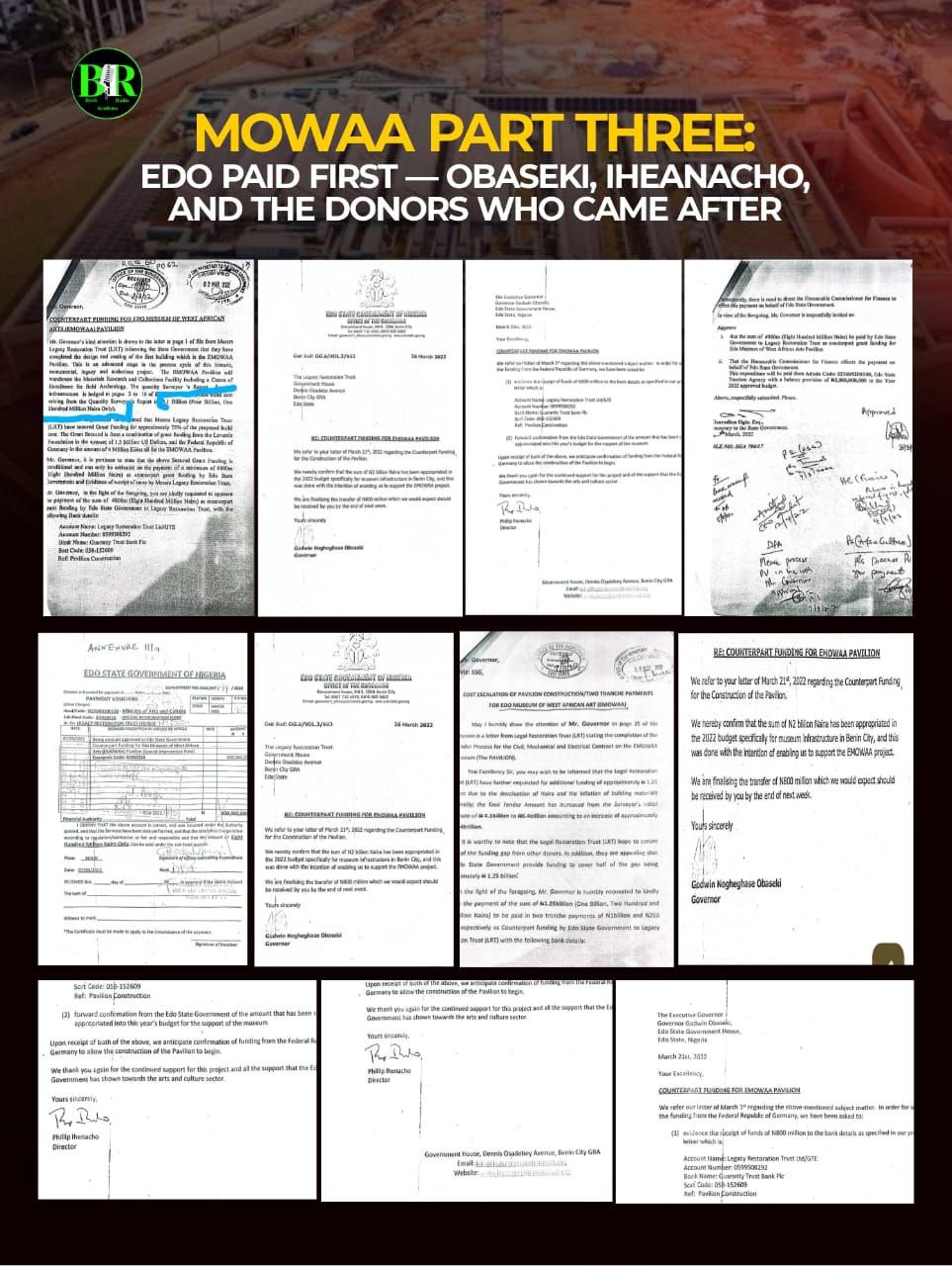
MOWAA Part Three: Edo Paid First — Obaseki, Iheanacho, and the Donors Who Came After....KINDLY READ THE FULL STORY HERE▶
Documents relating to the Museum of West African Art (MOWAA) reveal a funding structure that sharply contradicts the public narrative of a donor-driven heritage initiative. While MOWAA has been widely presented as a global philanthropic project supported by international partners, official correspondence, payment records, and funding schedules show that Edo State Government provided the land, paid first, absorbed financial risk, and ultimately financed almost the entire original cost of the pavilion.
The Approved Cost
The Bill of Quantities prepared by SEA Surveyors Limited fixed the cost of the EMOWAA Pavilion at ₦4.15 billion. This figure represented the official tender value, covering construction, preliminaries, external works, contingencies, and VAT. It is the benchmark against which all subsequent payments must be measured.
Donor Funding Was Conditional
Contrary to the perception that donor funds led the project, a formal letter dated 21 March 2022, issued by Legacy Restoration Trust and signed by Philip Iheanacho, made it clear that international donor funding — specifically from Germany — would not be released until Edo State first deposited ₦800 million as counterpart funding. Edo’s payment was therefore not supplementary; it was a precondition.
Edo Paid First
Five days later, on 26 March 2022, Edo State Government confirmed budgetary provision of ₦2 billion for museum infrastructure and approved the immediate release of ₦800 million. A payment voucher subsequently confirmed that the amount was paid into the account of Legacy Restoration Trust Ltd/GTE as counterpart funding for the pavilion.
At this point, donor funds had not yet been released. Edo’s money effectively activated the project.
Counterpart Funding Escalated
Rather than tapering after initial donor inflows, Edo State continued to fund the project in multiple tranches to meet construction timelines and rising costs. Documented payments and requests show:
-
initial tranches of ₦300 million and ₦700 million,
-
confirmation of ₦1.5 billion already paid, and
-
further requests for ₦1 billion, justified by inflation, foreign exchange volatility, and material cost increases.
By 2023–2024, Edo State’s total exposure had climbed to approximately ₦3.8 billion — nearly the full original pavilion cost of ₦4.15 billion.
Edo Bore the Risk
Throughout this period, Edo State:
-
provided prime land for the project, with no publicly disclosed valuation or equity recognition;
-
absorbed inflationary pressures as costs escalated;
-
bore foreign exchange risk arising from naira depreciation; and
-
responded to repeated funding appeals to prevent construction delays.
In effect, Edo State functioned as the financial shock absorber for the project.
Donor Claims and the Sequence Problem
While Edo continued to pay, public statements at international and local forums by Philip Iheanacho and Ike Chioke, presented as the drivers of MOWAA’s fundraising, stated that over $25 million had been raised internationally.
The sequence exposed by the documents raises a fundamental inconsistency: if donor funds were available at that scale, why did Edo need to continue releasing billions to keep the project afloat? The records show donor commitments following, not preceding, Edo’s payments.
One Financial Pipeline
Despite name changes — from Legacy Restoration Trust to EMOWAA and later MOWAA — all funding appeals and payment instructions directed funds through the same structure. Correspondence requesting funds, acknowledging payments, and urging urgency consistently bore the same signatory.
For a project combining public funds, international donations, and cultural heritage assets, this concentration of financial control stands out against accepted governance norms that typically require multi-signatory and institutional safeguards.
A Donor Initiative or a Taxpayer Project?
Taken together, the documents establish a clear sequence:
-
Edo provided the land.
-
Edo paid first.
-
Edo unlocked donor participation.
-
Edo absorbed inflation and FX risk.
-
Edo’s payments nearly matched the project’s original cost.
Yet the project continued to be publicly framed as donor-led.
This is the core discrepancy. A project built on Edo land, justified by Edo heritage, stabilised by Edo funds, and de-risked by Edo taxpayers cannot credibly be described as donor-driven without full financial reconciliation and disclosure.
Why the Questions Persist
The issue is not artistic ambition or cultural value. It is financial truth and public accountability. At minimum, the records warrant:
-
a consolidated, audited statement of all donor inflows and public payments,
-
a clear reconciliation of the $25 million fundraising claims with actual receipts,
-
disclosure of how public funds were protected, and
-
governance arrangements that reflect Edo’s dominant financial exposure.
Until these questions are answered, the gap between public narrative and documented reality will continue to fuel scrutiny.
Osigwe Omo-Ikirodah
Principal and CEO, Bush Radio Academy
Imo State Governor, Hope Uzodinma, has urged voters across the South-East to support President Bola Tinubu’s re-election bid in the 2027 general election.....KINDLY READ THE FULL STORY HERE▶
Uzodinma warned that ongoing development projects in the region could be discontinued if Tinubu fails to secure a second term in office.
He made the appeal on Monday at the All Progressives Congress (APC) presidential campaign rally held in Abakaliki, the Ebonyi State capital.
The governor encouraged residents of the South-East to participate actively in the forthcoming election by obtaining their Permanent Voter Cards (PVCs) and voting for Tinubu.
He stressed that their participation would play a significant role in determining the country’s political direction.
Uzodinma also referenced an address delivered by Ebonyi State Governor, Francis Nwifuru, during the rally, in which he presented a charter of needs outlining the expectations of the South-East and Nigerians generally.
According to the Imo governor, the demands and expectations highlighted by Nwifuru should guide the people’s decisions as they prepare for the 2027 presidential election.
He said, “I saw the governor of Ebonyi State in his address. He read what is called the Charter of Needs for the people, for South-East people, and indeed for Nigeria.
“Our responsibility will start from now to go and look for our PVC. That is the weapon, because if President Tinubu is not re-elected, all these ongoing projects will stop. So we have to sharpen our weapon, and our weapon is our voter card.”
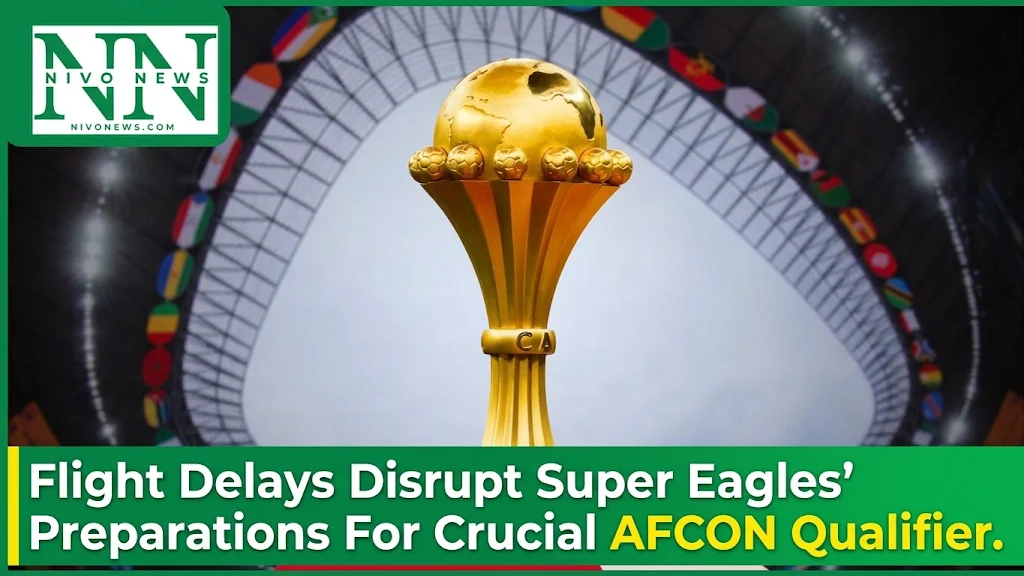
The Super Eagles of Nigeria and Tanzania have encountered disruptions in their preparations for Friday’s 2027 Africa Cup of Nations (AFCON) qualifier in Uyo following reported changes to their flight schedules.....KINDLY READ THE FULL STORY HERE▶
Super Eagles head coach Eric Chelle arrived in Uyo in the early hours of Monday and was later joined by one of his assistants, Daniel Ogunmodede. However, the team was yet to commence full training as the invited players had not arrived at the camp.
Sources in Uyo told Punch that no Super Eagles player had arrived at the Victor Attah International Airport as of Monday evening, despite team officials waiting at the airport throughout the day.
One of the sources said: “We were at the airport from morning until evening on Monday, and none of the players arrived. When the last flight of the day landed, we checked the manifest, but no player was on board.”
Tanzania also experienced a delay in its travel arrangements. The Taifa Stars, who were initially expected to arrive in Uyo on Monday, were rescheduled to land on Tuesday following changes to their flight schedule.
The East African side have endured a difficult start to their Group L campaign, suffering a 2-0 defeat to Guinea-Bissau before settling for a 1-1 draw against Madagascar.
However, Tanzania have already secured automatic qualification for the 2027 AFCON as co-hosts alongside Kenya and Uganda. This leaves only one available qualification spot in Group L.
Guinea-Bissau currently top the group, while Nigeria sit in second position with three points from two matches.
The Super Eagles began their campaign with a 2-1 victory over Madagascar in Uyo but suffered a disappointing 3-0 loss to Guinea-Bissau in Bissau.
Chelle will be hoping to assemble his squad as quickly as possible ahead of the double-header, with Nigeria needing maximum points to improve their chances of securing the group’s remaining qualification ticket.
The coach announced a 24-man squad on Saturday but will be without striker Victor Osimhen, who has been ruled out of the encounter due to injury. The Galatasaray forward also missed Nigeria’s previous two qualifiers against Madagascar and Guinea-Bissau in September.
Other players invited include goalkeepers Stanley Nwabali and Arthur Okonkwo; defenders Olaoluwa Aina and Benjamin Frederick; midfielders Tochukwu Nnadi and Samson Tijani; and forwards Moses Usor and Taiwo Awoniyi.
Turkey-based defender Chibuike Nwaiwu and Czechia-based wing-back Abdullahi Bewene are also part of the squad.
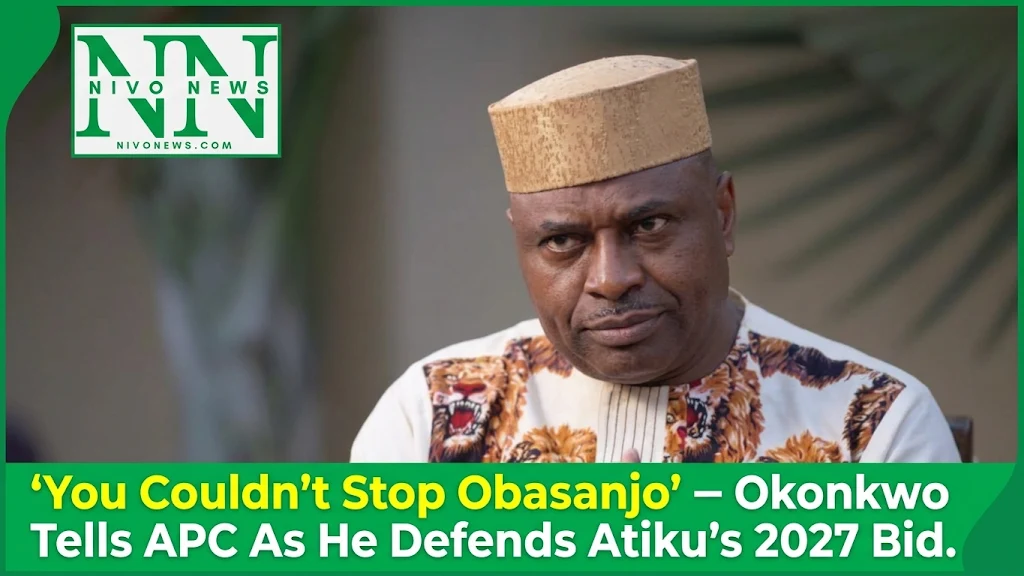
The campaign spokesperson for the African Democratic Congress (ADC) presidential candidate, Atiku Abubakar, Kenneth Okonkwo, has expressed confidence that his principal will appear on the ballot in the 2027 presidential election.....KINDLY READ THE FULL STORY HERE▶
Okonkwo accused the ruling All Progressives Congress (APC) of making efforts to prevent Atiku from contesting the election, insisting that the party’s alleged attempts would ultimately fail.
He drew a comparison with the 2007 presidential election, when former President Olusegun Obasanjo reportedly made efforts to stop Atiku, who was then his vice president, from contesting the presidency.
Naija News reports that the actor-turned-politician maintained that the APC would suffer the same outcome as Obasanjo, who failed to prevent Atiku from participating in the 2007 election.
Okonkwo also predicted that Atiku would emerge as Nigeria’s next president.
In a post shared on X, he said the APC’s alleged attempts to frustrate Atiku’s ambition had strengthened his belief in the ADC candidate’s chances.
He wrote:
“The more the incompetent and corrupt APC tackles ADC, and the more they try to block Atiku Abubakar from contesting for the post of President in 2027, the more I am convinced that Atiku Abubakar is the next President of Nigeria because you do not cast a stone at a tree that is not bearing any fruit.
“APC should learn from history, and understand that Atiku is unstoppable. President Olusegun Obasanjo did everything possible, with all the powers of the security apparatus, to stop Atiku, his Vice President, from contesting the 2007 presidential election, but failed.
“Atiku succeeded through the rule of law by ventilating his agitation through the courts. This time around in 2027, Atiku will win again because God and the people of Nigeria are on his side.
“Let me reiterate, Atiku and ADC will be on the ballot in 2027 and will win the 2027 presidential election for the security and welfare of Nigerians.
-

 latest1 year ago
“Social Media Erupts As Jim Iyke Declares Rita Dominic Nollywood’s Most Beautiful”
-
 latest3 years ago
Edo Political Showdown: Oshiomhole Appears At Presidential Villa As Tinubu Hands APC Gubernatorial Flag To Okpebholo (Photos & Video)
-
 entertainment3 years ago
Love Knows No Age American Woman Defends Marriage To Young Nigerian Man “I’m Not 70”
-
 latest3 years ago
Olumide Akpata Strikes Again: Drops Killer Track, Sends Edo State Into Frenzy!(Video)
-
 Politics3 years ago
Nigerians React As Pastor Adeboye Foresees Passing Away On A Sunday After Enjoying A Satisfying Meal Of Pounded Yam
-
 latest3 years ago
FG Identifies 31 States At Risk Of Heavy Flooding In 2024: See Full List
-
 Politics3 years ago
BREAKING: Inspector-General Of Police Summons Top Police Commanders For Crucial-Security Challenges
-
 latest3 years ago
5 NYSC Corpers Perish In Fatal Road Accident Returning From Camp