
Latest News
Vanishing Billions: Maryam Abacha Breaks Silence on Missing Fortune After Husband’s Death”


Maryam Abacha Denies Looting Allegations, Questions Narratives About Late Husband....KINDLY READ THE FULL STORY HERE▶
Maryam Abacha, widow of Nigeria’s former military Head of State, General Sani Abacha, has dismissed long-standing allegations that her late husband looted billions of dollars during his tenure, asserting there is no credible proof to back such claims.
In an interview with TVC on Sunday, Mrs. Abacha challenged the decades-old accusations, questioning both the evidence and motivations behind the negative portrayal of her husband’s legacy.
“Who are the witnesses to these so-called stashed funds? Did anyone see signatures or tangible proof of money hidden abroad?” she asked.
She also alleged that some of the funds her husband reportedly secured for Nigeria mysteriously disappeared shortly after his death. “The money my husband kept for Nigeria vanished within months of his passing, yet no one talks about that,” she said.
Mrs. Abacha criticized what she called an unrelenting focus on her husband nearly three decades after his death, suggesting the scrutiny could be rooted in tribal or religious bias. “Why do we keep blaming one person? Is it tribalism, religion, or something else wrong with us as Nigerians?” she asked. “Why are we so hostile toward each other?”
She also took aim at the media, urging journalists to adopt a more balanced and constructive approach. “People aren’t as bad as they’re made to seem. It’s been 27 years, and yet people are still talking about Abacha. He must have been powerful and loved. We thank God for that,” she remarked.
Addressing public comments that referenced the relative economic stability during her husband’s regime — including increased foreign reserves and reduced external debt — she reiterated her stance that there was no financial misconduct. “If the economy was stable, then from where exactly did he steal?” she asked. “But Nigerians are too quick to believe everything.”
Mrs. Abacha concluded by calling for national unity and mutual respect, emphasizing that no individual is greater than the country. “Babangida didn’t build Nigeria alone. Abacha didn’t. Neither did Abiola. Even the man on the street matters. We are all human beings. All this trouble must end.”

The Nigeria Police Force has rescued 20 prospective National Youth Service Corps members who were abducted along the Owerri-Onitsha Expressway in Imo State.....KINDLY READ THE FULL STORY HERE▶
The corps members were rescued on October 7, 2026, at Amakohia Ubi in the Owerri West Local Government Area of the state following a coordinated operation involving the police and other security agencies.
The Force Public Relations Officer, CSP Ani Iniedu, disclosed the development in a statement on Tuesday.
Iniedu said the rescued victims had been taken for medical assessment and were receiving the necessary care.
The statement read:
“The Nigeria Police Force, in collaboration with sister security agencies, rescued the 20 prospective NYSC corps members abducted in Imo State on 1st October 2026.
“The victims were rescued on 7th October 2026 at Amakohia Ubi Village, Imo State, following sustained search-and-rescue operations. They have since been taken for medical assessment and necessary care.”
The prospective corps members were reportedly travelling to their orientation camp when gunmen attacked their convoy along the Owerri-Onitsha route.
The police said efforts were ongoing to identify and apprehend those responsible for the abduction.
According to the statement, security agencies would continue coordinated operations until all those involved were brought to justice.
“Efforts are ongoing to apprehend those responsible for the abduction, as the Police and other security agencies sustain coordinated operations towards bringing all culpable persons to justice,” the statement added.
The Force thanked members of the public for their cooperation and support, while assuring Nigerians of its continued commitment to protecting lives and property.
“The Nigeria Police Force appreciates members of the public for their cooperation and support and remains committed to the protection of lives and property, prompt response to security threats and continued collaboration with sister security agencies,” the statement said.

Kenya Airways has confirmed the death of a passenger aboard one of its flights from Nairobi, Kenya, to Lagos on Tuesday.....KINDLY READ THE FULL STORY HERE▶
News reports that the airline disclosed in a statement on Wednesday that the passenger became unresponsive about 20 minutes before the aircraft arrived at Murtala Muhammed International Airport, Lagos.
The airline expressed condolences to the deceased’s family and friends while apologising for any inconvenience the incident may have caused.
Kenya Airways also said it was providing the necessary support in coordination with the deceased’s family, relevant local authorities and aviation regulators.
The statement read, “Our crew administered first aid as per their training and followed all emergency procedures.
“Upon landing at Murtala Muhammed International Airport at 21:41 hrs, the aircraft was met by medical personnel, and upon further examination, the medical personnel confirmed that the passenger had passed away.
“We uphold and respect the privacy and dignity for all involved.”
Pastor Dies After Collapsing While Preaching at Funeral
In a related development, the pastor in charge of the Redeemed Christian Church of God, Glorious People Assembly, Aleto, Deacon Steve Eyo, has died after collapsing while preaching at a funeral service in Aleto, Eleme Local Government Area of Rivers State.
According to Leadership, Eyo was delivering a sermon at the funeral of a female member of his church on Friday when he suddenly collapsed.
The incident reportedly shocked mourners who had gathered for the burial.
Eyo was subsequently taken to a nearby medical facility for treatment using an ambulance that had been hired to transport the remains of the deceased person whose funeral was being held.
He was, however, pronounced dead at the hospital.
During his sermon, Eyo had reportedly spoken about the certainty of death and the importance of living with the awareness that life can end at any time.
He began preaching at about 1:10 p.m. and reportedly collapsed approximately 15 minutes later as he was concluding his message.
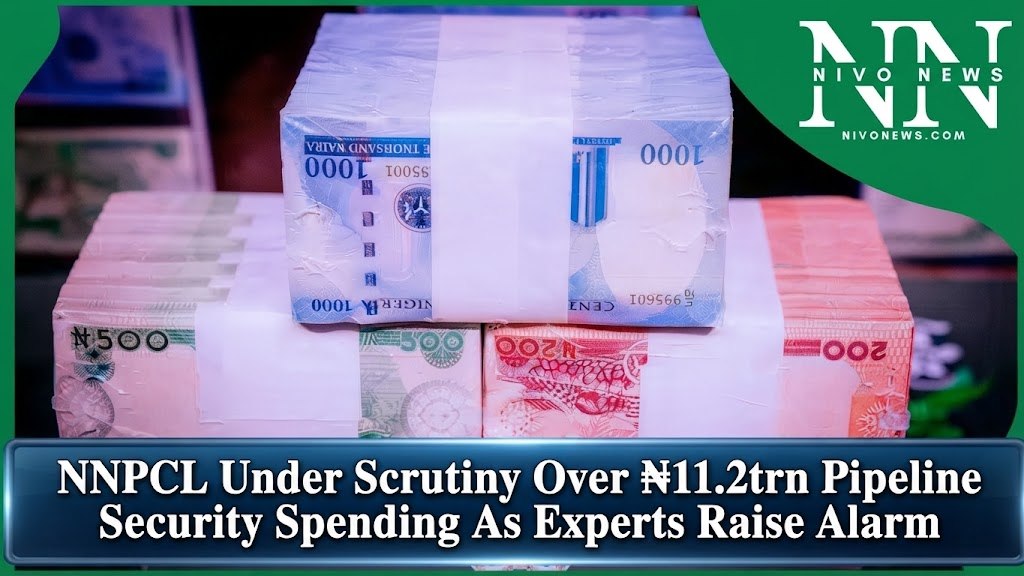
Questions have been raised over the Nigerian National Petroleum Company Limited’s (NNPCL) reported expenditure of ₦11.2 trillion on pipeline surveillance and security-related activities in 2025.....KINDLY READ THE FULL STORY HERE▶
The concerns followed the release of the company’s 2025 audited financial statements, with energy experts demanding greater transparency on how the money was spent and the value Nigeria derived from the expenditure.
NNPCL reported a 33 per cent increase in Profit After Tax (PAT), which rose from ₦5.4 trillion in 2024 to ₦7.2 trillion in 2025.
However, the company’s revenue declined by 24 per cent to ₦34.5 trillion during the same period.
The financial statements showed ₦11.2 trillion under the heading, “pipeline surveillance and other receivables from federation.”
NNPCL explained that the figure represented advance payments to the Federation as well as costs incurred in securing the country’s oil and gas assets.
The company also clarified that it did not record expenditure under “energy security,” a term it uses in relation to spending associated with fuel subsidy.
The ₦11.2 trillion figure has nevertheless attracted significant attention because it exceeds NNPCL’s ₦7.2 trillion profit for the year.
In 2024, NNPCL reported ₦7.1 trillion in energy security expenditure, while its combined spending on pipeline security was put at ₦17.5 trillion.
Former Vice President and 2027 African Democratic Congress (ADC) presidential candidate, Atiku Abubakar, recently called on the administration of President Bola Tinubu to explain how the ₦11.2 trillion was spent.
Atiku argued that the expenditure required proper scrutiny, noting that the amount was several times higher than Nigeria’s defence budget allocation of approximately ₦3.1 trillion.
Energy expert and petroleum economist, Professor Wumi Iledare, said the focus should go beyond the size of the expenditure to determine the actual value Nigeria received from the spending.
Speaking on Arise, Iledare said NNPCL should demonstrate the benefits derived from the funds used to secure the country’s oil assets.
“The magnitude must be questioned. And those are professional scepticism that NNPC is willing to look at,” he said.
Iledare asked what Nigeria had gained from the ₦11.2 trillion expenditure, noting that resources could either be used to increase production or ensure the uninterrupted flow of crude from existing assets.
Other experts have similarly questioned the spending while acknowledging the importance of protecting Nigeria’s oil and gas infrastructure.
‘Government Stashing Funds For 2027’
In a separate interview with Daily Post, Managing Partner of BBH Consulting and Convener of the Public Interest Advocacy Network (PIAN), Barrister Ameh Madaki, described the reported expenditure as excessive.
Madaki questioned the effectiveness and value of the pipeline surveillance arrangements, while also demanding accountability over the funds.
He asked why NNPCL would spend ₦11.2 trillion on pipeline surveillance across the Niger Delta.
Madaki further alleged that the expenditure could be connected to political preparations ahead of the 2027 general elections, although the claim has not been independently established.
“Every discerning Nigerian knows that this unaccountable government is stashing funds away for the 2027 elections and massive vote-buying under the guise of a criminal pipeline surveillance system which has nothing to offer,” he alleged.
However, oil and gas consultant and public affairs analyst, Chuks Emeka, offered a different perspective, stressing that securing Nigeria’s oil infrastructure was necessary but insisting that the expenditure must be transparent.
Emeka said pipeline vandalism, crude oil theft and attacks on critical infrastructure could negatively affect oil production, discourage investment and reduce government revenue.
“My position is that the security of Nigeria’s oil and gas infrastructure is absolutely necessary,” he said.
He, however, cautioned against presenting the entire ₦11.2 trillion as fresh cash spent exclusively on pipeline security.
According to Emeka, the 2025 audited accounts classified the amount as receivables from the Federation, covering advances and costs incurred on behalf of the government, including expenses associated with protecting oil and gas assets.
“It should therefore not simply be presented as N11.2 trillion in fresh cash spent solely on pipeline security in 2025,” he said.
Despite this clarification, Emeka agreed that Nigerians deserved a detailed breakdown of how the funds were utilised.
He asked how much was spent on surveillance, security operations, community-based surveillance and other interventions, as well as details of contracts awarded, beneficiaries and the measurable results achieved.
‘Security Spending Must Not Become Blank Cheque’
Emeka also noted that improved security around oil infrastructure appeared to have contributed to increased crude oil production.
He said NNPCL reported that average crude production had risen from the low levels recorded in 2022 to about 1.71 million barrels per day in 2025.
“There is evidence that improved pipeline security has contributed to increased crude production,” he said.
Emeka stressed that he was not opposed to spending money to secure Nigeria’s pipelines, but maintained that the country must determine whether it was receiving value commensurate with the funds being committed.
He called for a security model capable of protecting oil facilities, keeping production infrastructure operational and giving host communities a meaningful role in safeguarding the assets.
He added that such a system must be transparent, independently audited and economically efficient.
“At a time when Nigerians are facing significant cost-of-living pressures, every trillion naira committed by the government must be subjected to rigorous scrutiny,” Emeka said.
“Security is necessary, but security spending should not become a blank cheque.”
According to him, the central issue is not whether Nigeria should invest in pipeline security, but how much is being spent, who is receiving the funds, how the money is being utilised and what measurable benefits the country is getting in return.
-

 latest1 year ago
“Social Media Erupts As Jim Iyke Declares Rita Dominic Nollywood’s Most Beautiful”
-
 latest3 years ago
Edo Political Showdown: Oshiomhole Appears At Presidential Villa As Tinubu Hands APC Gubernatorial Flag To Okpebholo (Photos & Video)
-
 entertainment3 years ago
Love Knows No Age American Woman Defends Marriage To Young Nigerian Man “I’m Not 70”
-
 latest3 years ago
Olumide Akpata Strikes Again: Drops Killer Track, Sends Edo State Into Frenzy!(Video)
-
 Politics3 years ago
Nigerians React As Pastor Adeboye Foresees Passing Away On A Sunday After Enjoying A Satisfying Meal Of Pounded Yam
-
 latest2 years ago
FG Identifies 31 States At Risk Of Heavy Flooding In 2024: See Full List
-
 Politics3 years ago
BREAKING: Inspector-General Of Police Summons Top Police Commanders For Crucial-Security Challenges
-
 latest3 years ago
5 NYSC Corpers Perish In Fatal Road Accident Returning From Camp