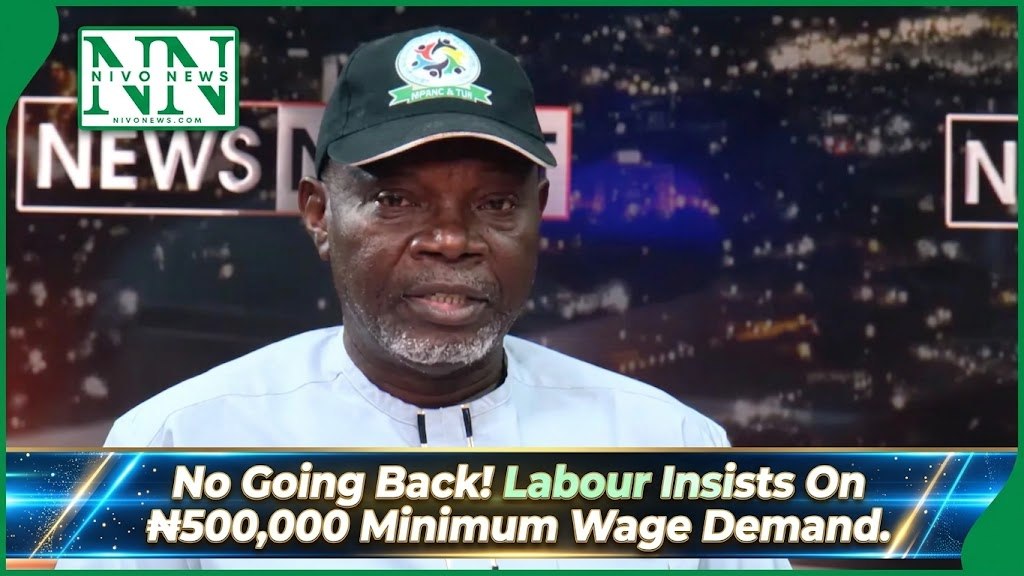
Organised labour has reiterated its demand for a ₦500,000 minimum wage, arguing that the amount reflects the economic challenges Nigerian workers face amid the rising cost of living.....KINDLY READ THE FULL STORY HERE▶
The National Secretary of the Joint National Public Service Negotiating Council (JNPSNC), Gbenga Olowoyo, stated this during an interview on Arise News on Tuesday.
However, Olowoyo said labour remained open to reasonable negotiations with the Federal Government to reach a mutually acceptable figure.
His comments followed a six-hour meeting between organised labour and the Federal Government to discuss workers’ welfare and measures to ease the impact of rising petrol prices.
Olowoyo welcomed the government’s agreement to provide workers with ₦70,000 monthly transport support for six months, beginning in November 2026.
He described the outcome of the meeting as encouraging, noting that the lengthy discussions had produced a positive development for workers.
“I think with the recent development that happened today, the negotiation lasted over six hours, and with the outcome of the meeting, I think it is a good omen,” he said.
The labour leader explained that the transport intervention would benefit workers at all levels, including those at the grassroots, amid concerns about rising transportation costs and the growing pressure on household finances.
He, however, emphasised that the ₦70,000 monthly support was a temporary measure and would not replace labour’s demand for a new minimum wage.
“The template of ₦500,000 is still subsisting. And at the same time, if government is able to dance around ₦500,000, we would be alright to support the President. So I want to believe that, as I told you, we are not going to be rigid, but at the same time, we’ll be reasonable,” Olowoyo stated.
He explained that the proposed minimum wage was intended to help workers meet essential responsibilities, including feeding their families, paying school fees and covering other basic expenses.
Olowoyo also expressed optimism that the agreement would create room for further discussions, particularly the establishment of a tripartite committee to negotiate a new minimum wage, which remains one of labour’s major demands.
According to him, the Federal Government’s decision to sign an agreement with organised labour demonstrated its willingness to address the concerns raised by workers.
He noted that the outcome of the negotiations would extend beyond the unions directly involved, given that the Nigeria Labour Congress (NLC) has more than 40 affiliate unions.
The negotiations initially involved the JNPSNC and eight other unions before the NLC joined the discussions, broadening the representation of workers.
Describing the outcome as a collective victory, Olowoyo expressed confidence that the government would fulfil its commitment to the transport allowance.
“We know government is going to implement it because that is commitment already,” he said.
The six-month transport support programme is expected to run from November 2026 to April 2027. Olowoyo said organised labour hoped to conclude negotiations on the new minimum wage before the temporary intervention expires.
He added that the coming months would provide an opportunity for both parties to resolve outstanding issues and agree on a wage structure that reflects the economic realities confronting Nigerian workers.