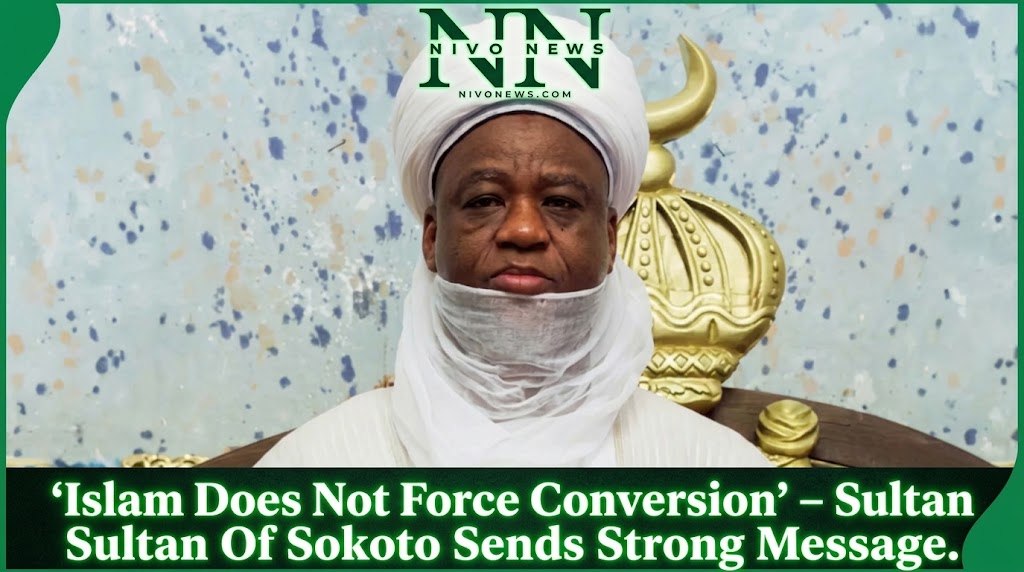
The Sultan of Sokoto, Muhammadu Sa’ad Abubakar III, has cautioned Muslims against compelling anyone to embrace Islam, emphasising that the religion does not permit coercion or forced conversion.....KINDLY READ THE FULL STORY HERE▶
He urged Muslims to demonstrate the values of their faith through their actions and promote peaceful coexistence with people of other religious beliefs.
The Sultan spoke on Monday during the closing ceremony of activities marking his 20th anniversary on the throne and the 13th Sheikh Usmanu Bin Fodiyo Week in Sokoto.
Abubakar, who also serves as the President-General of the Nigeria Supreme Council for Islamic Affairs, described himself as “a soldier of Islam and a soldier of peace”, noting that much of his time as a traditional and religious leader had been devoted to resolving conflicts and restoring peace in communities.
“Before I became Sultan here, I was a soldier. I am still a soldier, a soldier of Islam and a soldier of peace, because what I spend most of my time doing is bringing peace to communities,” he said.
He also encouraged Nigerians to draw lessons from the founding principles of the Sokoto Caliphate to strengthen governance and tackle the country’s social challenges.
According to him, the caliphate was founded on sound human relationships, respect for human dignity and devotion to God. He said these principles provided society with peace, strength, purpose and direction.
The Sultan maintained that the values remained relevant despite the social, economic and political changes that had taken place over the years.
He blamed British colonial rule for introducing systems and structures that continued to serve colonial interests while hindering Africans from overcoming colonial attitudes and values.
“Indeed, more so, because what replaced the caliphate was the British colonial rule, which was exploitative and subversive, even if subterranean. The nearly 60 years of this exploitative rule have had the misfortune of installing systems and structures that not only continue to benefit the colonial enterprise but also undermine our recovery from colonial morality and mentality,” he said.
Abubakar described the Sokoto Caliphate as evidence of the capacity of African scholars to establish a society, government and economy founded on the rule of law.
He said the caliphate’s history and legacy could offer valuable lessons for Africa’s development and liberation.
The Sultan further urged Muslim scholars to promote the spirit of brotherhood taught by Prophet Muhammad and educate the public on the role of the caliphate in uniting people from different ethnic backgrounds.
Meanwhile, Zamfara State Governor Dauda Lawal congratulated the Sultan on his 20th anniversary on the throne, describing his reign as one characterised by humility, unity, stability, religious tolerance and national cohesion.
Lawal said the Sultan’s counsel and interventions had continued to play an important role in addressing Nigeria’s economic, social and security challenges.
He called on Islamic scholars, traditional rulers, community leaders and youth organisations to encourage peaceful coexistence, discourage extremism and promote values such as honesty, compassion and respect for human life.
The governor also stressed that achieving lasting peace required more than security operations, noting the importance of quality education, economic opportunities, sound moral values and active community participation.
Similarly, Sokoto State Governor Ahmed Aliyu, represented by his deputy, Idris Gobir, commended the Sultan for his contributions to religious tolerance, peaceful coexistence and national development.
Aliyu said the anniversary offered an opportunity to reflect on the intellectual heritage of the Sokoto Caliphate, particularly the teachings of Sheikh Usmanu Bin Fodiyo, Abdullahi Fodio and Sheikh Muhammad Bello.
He highlighted their contributions to scholarship, moral reform, social responsibility, justice, accountability and good governance.