
Economy
“Sallah Crisis: Millions Of Nigerians Groan As Cooking Gas Skyrockets To ₦2,000/kg Ahead Of Festive Holidays”.

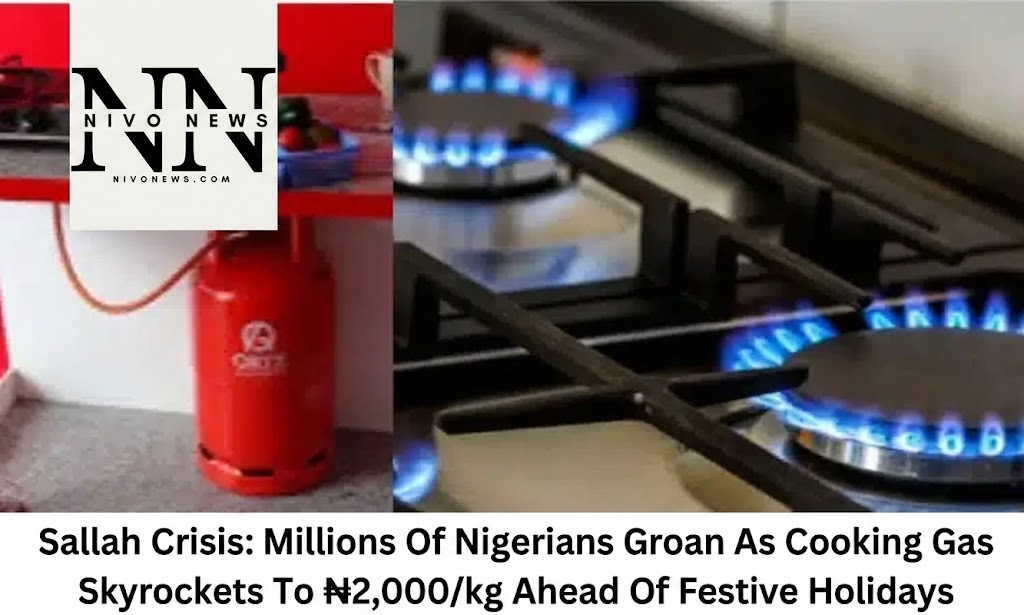
As Nigerian Muslims prepare for the 2026 Eid-el-Kabir celebrations, the soaring cost of Liquefied Petroleum Gas (LPG), commonly known as cooking gas, is causing widespread anxiety across the nation. This economic strain comes right after the Federal Government declared Wednesday, May 27, and Thursday, May 28, 2026, as public holidays for the Sallah festivities.....KINDLY READ THE FULL STORY HERE▶
A market survey reveals a staggering price hike for a product that previously sold below ₦1,000 per kilogramme. LPG now commands between ₦1,500 and ₦2,000 across various regions. In parts of the South-West, including Lagos, Abeokuta, and Ibadan, prices hover between ₦1,600 and ₦1,700/kg, surging up to ₦2,000/kg in Ogun State border communities. The situation is equally grim in several northern states, where prices range firmly between ₦1,800 and ₦2,000/kg.
Expressing frustration, a consumer named Borokinni lamented the lack of government support for ordinary citizens, stating, “One of the only ways the government can assist the masses is through affordable cooking gas, but Nigerian leaders don’t care.”
Meanwhile, the Nigerian Association of Liquefied Petroleum Gas Marketers (NALPGAM) has raised the alarm over irregular supplies and the sudden price spike. In a joint statement by National President Edu Inyang and Executive Secretary Bassey Essien, the association warned that the current crisis could trigger severe scarcity and deepen economic hardship. Marketers are reportedly paying an unprecedented ₦25.2 million to ₦26.2 million for 20 metric tonnes of LPG.
NALPGAM described the trend as “pathetic” and expressed fears that public anger could soon be directed at gas retail outlets. They emphasized that the hike drastically impacts households, food vendors, and small businesses, threatening to erase years of progress made in clean energy adoption.
Alarmingly, the group noted that many low-income earners are already abandoning gas and returning to charcoal and firewood. With neighborhood retail outlets already running dry, citizens are calling for immediate federal intervention to stabilize supply and prices before the holidays begin.
Option 2: Sharp and Punchy (High Engagement / Fast-Paced)
Headline: Sallah Hardship: Cooking Gas Hits ₦2,000/kg as Marketers Warn of Looming Scarcity
A severe surge in cooking gas prices is threatening to ruin the 2026 Eid-el-Kabir celebrations for millions of Nigerians, with costs hitting as high as ₦2,000 per kilogramme in some parts of the country.
Despite the Federal Government declaring May 27 and 28 as public holidays, festive preparations have been overshadowed by inflation. In Lagos, Oyo, and parts of the North, consumers are paying anywhere between ₦1,600 and ₦2,000/kg for a commodity that once cost less than ₦1,000/kg.
The Nigerian Association of Liquefied Petroleum Gas Marketers (NALPGAM) has warned that the situation is critical. Marketers are currently shelling out between ₦25.2m and ₦26.2m for 20 metric tonnes of LPG, a cost burden that is being passed directly to already struggling households.
NALPGAM cautioned that if the price spiral isn’t checked immediately, frustrated citizens might revolt against gas station owners. The association also lamented that the crisis is forcing families back to using firewood and charcoal, effectively killing Nigeria’s clean energy progress and driving up food inflation.
As local retail shops begin to report gas shortages, desperate citizens are urging the government to step in before the Sallah holidays kick off.
Option 3: Impact & Consumer-Focused Style
Headline: ‘Nigerian Leaders Don’t Care’ — Consumers Cry Out as Cooking Gas Prices Explode Ahead of Sallah
The joy of the upcoming Eid-el-Kabir festivities is rapidly fading for many Nigerian households as the price of cooking gas experiences a massive pre-Sallah explosion, nearing ₦2,000 per kilogramme nationwide.
Reports indicate that in the South-West and Northern regions, prices have leaped from under ₦1,000/kg to peak between ₦1,700 and ₦2,000/kg. “The government should at least make cooking gas affordable for the masses,” a frustrated consumer named Borokinni stated, accusing leadership of ignoring public welfare.
The crisis has triggered panic within the Nigerian Association of Liquefied Petroleum Gas Marketers (NALPGAM). The leadership revealed that the wholesale price for 20 metric tonnes has reached a staggering ₦26.2 million.
According to NALPGAM, the current price regime is a massive blow to small scale businesses, food vendors, and low-income homes. They warned that the trend is actively reversing Nigeria’s transition to clean energy, as thousands of households are officially reverting to firewood and charcoal due to sheer unaffordability.
With neighborhood depots already facing supply shortages, the public is demanding immediate government intervention to crash the prices before Wednesday’s public holiday.
Economy
THE COST OF COOKING: Inside The Brutal Market Surge Pushing Everyday Gas Beyond The Reach Of Millions!.
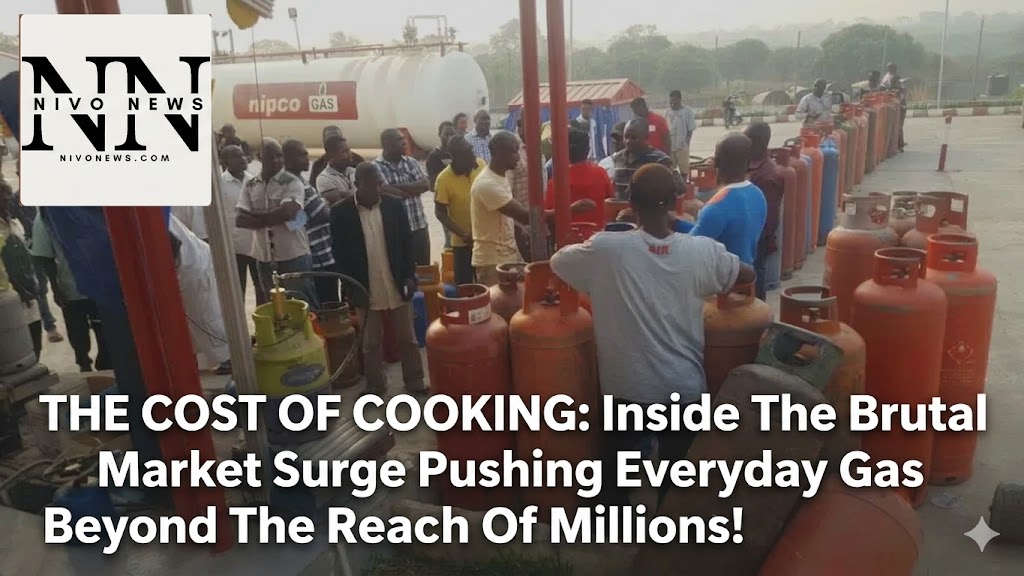
The Nigerian Association of Liquefied Petroleum Gas Marketers (NALPGAM) has raised a major alarm over chaotic supply drops and skyrocketing cooking gas prices, warning that the crisis could trigger a massive public backlash against gas station owners. A new statement signed by National President Edu Inyang and Executive Secretary Bassey Essien reveals that cooking gas has officially shattered the ₦1,500 per kg mark in multiple regions, with some dealers hiking prices up to ₦2,000. Marketers are currently being forced to shell out a staggering ₦25.2 million to ₦26.2 million just to secure a single 20-metric-tonne truck.....KINDLY READ THE FULL STORY HERE▶
NALPGAM labeled the economic squeeze “pathetic,” warning that persistent shortages, soaring depot rates, and logistics bottlenecks are completely destroying Nigeria’s clean energy gains. With millions of households and small businesses priced out, vulnerable families are rapidly abandoning gas cylinders and reverting to unhealthy firewood and charcoal. The association is making a passionate appeal to the Federal Government, NNPC, and regulatory bodies to intervene immediately before the market completely collapses and triggers severe food inflation and job losses.
Option 2: Sensational & Punchy (Best for Social Media/Bulletins)
KITCHEN EMERGENCIES: 5 Shocking Bombshells From Gas Marketers as Prices Explode Past ₦1,500/Kg
The Rebellion Warning: NALPGAM warns that if the government fails to check the crazy price hikes immediately, frustrated citizens might turn their anger against gas station owners.
The ₦2,000 Extreme: While the official average price has blown past ₦1,500 per kg, field checks reveal desperate retailers are selling the product for as high as ₦1,600 to ₦2,000 in certain locations.
The Depot Nightmare: Marketers expose the crushing operational costs behind the surge, revealing they now pay up to ₦26.2 million for a 20-metric-tonne supply.
The Environmental Setback: Years of clean energy progress are officially under threat as low-income families ditch their cylinders for deforestation-heavy firewood and charcoal.
The SOS to Government: Marketers are calling for an emergency intervention from the Ministry of Petroleum Resources and the NNPC to boost domestic allocation and crash the retail rates.
Option 3: Editorial & Analytical (Best for a Feature Column)
The Collapse of the Clean Energy Dream: Why the Cooking Gas Price Surge is a National Security Threat
Nigeria’s decades-long transition toward sustainable, clean cooking energy is on the verge of a total systemic collapse. A severe joint warning issued by the leadership of the Nigerian Association of Liquefied Petroleum Gas Marketers (NALPGAM) details a grim macroeconomic reality: cooking gas, once positioned as an affordable social item, has transformed into an elitist luxury selling for well over ₦1,500 per kilogram.
The logistics and supply chain crisis is hitting both ends of the market. While terminal and depot costs force marketers to risk millions on single shipments, the end consumers are simply voting with their wallets by returning to primitive biomass fuels like charcoal and firewood. NALPGAM’s warning that citizens may turn on retail infrastructure highlights the volatile undercurrents of the current economic hardship. For the Federal Government and regulatory bodies like NMDPRA, this is a clear call to eliminate importation bottlenecks and structurally overhaul domestic storage infrastructure before inflation completely decimates small-scale retail industries.

According to Nivo News, the World Bank has projected that Nigeria’s economy will grow by 4.4 percent in 2026 and 2027, driven by new tax legislation, prudent monetary policies, and ongoing economic reforms. The announcement was made in the bank’s January 2026 Global Economic Prospects report, which described the anticipated growth rate as the fastest for Nigeria in over a decade.....KINDLY READ THE FULL STORY HERE▶
This latest projection represents an upgrade from the World Bank’s previous forecast of 3.7 percent published in June 2025. The bank highlighted that reforms in the tax system, combined with continued monetary prudence, are expected to stimulate economic activity, improve investor confidence, and reduce inflation. It also noted that increased oil production is likely to offset lower global oil prices, boosting fiscal revenue and strengthening Nigeria’s external balance.
The projection comes against the backdrop of Nigeria’s Gross Domestic Product (GDP) growth of 3.98 percent year-on-year in real terms during the third quarter of 2025, as reported by the National Bureau of Statistics.

Nigeria’s headline inflation rate eased to 14.45 per cent year on year in November 2025, according to the latest Consumer Price Index (CPI) report released by the National Bureau of Statistics (NBS). The report showed that while consumer prices continued to rise on a monthly basis, annual inflation moderated significantly under the revised base year.....KINDLY READ THE FULL STORY HERE▶
The CPI increased to 130.5 points in November from 128.9 points in October, marking a 1.6-point month-on-month rise. Despite this, the headline inflation rate declined from 16.05 per cent recorded in October. The NBS highlighted that the November 2025 figure represents a 1.6 percentage point decrease compared with the previous month.
Monthly inflation, however, rose to 1.22 per cent in November from 0.93 per cent in October, indicating that average prices increased at a faster pace during the month despite the moderation in annual inflation. Headline inflation for November 2025 was 20.15 percentage points lower than the 34.60 per cent recorded in November 2024, reflecting the impact of the rebasing exercise that reset the base year to 2024 from 2009.
Over the twelve months ending November 2025, the average CPI increased by 20.41 per cent, down sharply from 32.77 per cent in the corresponding period of 2024. Food and non-alcoholic beverages remained the largest contributor to annual headline inflation at 5.78 percentage points, followed by restaurants and accommodation services at 1.87 percentage points, and transport at 1.54 percentage points. Housing, water, electricity, gas and other fuels added 1.22 percentage points, while education and health contributed 0.90 and 0.88 percentage points, respectively. On a month-on-month basis, food and non-alcoholic beverages drove price increases with a contribution of 0.49 percentage points.
Urban inflation declined sharply to 13.61 per cent year on year in November, down 23.49 percentage points from November 2024, while rural inflation remained higher at 15.15 per cent but fell 17.12 percentage points from the previous year. Month-on-month, urban inflation slowed to 0.95 per cent, while rural inflation accelerated to 1.88 per cent.
Food inflation moderated annually to 11.08 per cent in November 2025 from 39.93 per cent in November 2024. Monthly food inflation rose to 1.13 per cent, driven by price increases in items such as dried tomatoes, cassava tubers, ground pepper, eggs, crayfish, egusi, oxtail, and fresh onions. Core inflation, which excludes volatile agricultural and energy prices, stood at 18.04 per cent year on year, down from 28.75 per cent in November 2024.
State-level data showed Rivers recorded the highest year-on-year inflation at 17.78 per cent, followed by Ogun at 17.65 per cent and Ekiti at 16.77 per cent. Plateau had the lowest at 9.13 per cent, alongside Kebbi at 10.32 per cent and Katsina at 10.60 per cent. The NBS cautioned that interstate comparisons should be interpreted carefully due to differing consumption patterns and CPI weights across states.
-

 latest9 months ago
“Social Media Erupts As Jim Iyke Declares Rita Dominic Nollywood’s Most Beautiful”
-
 latest2 years ago
Edo Political Showdown: Oshiomhole Appears At Presidential Villa As Tinubu Hands APC Gubernatorial Flag To Okpebholo (Photos & Video)
-
 entertainment2 years ago
Love Knows No Age American Woman Defends Marriage To Young Nigerian Man “I’m Not 70”
-
 latest2 years ago
Olumide Akpata Strikes Again: Drops Killer Track, Sends Edo State Into Frenzy!(Video)
-
 Politics2 years ago
Nigerians React As Pastor Adeboye Foresees Passing Away On A Sunday After Enjoying A Satisfying Meal Of Pounded Yam
-
 latest2 years ago
FG Identifies 31 States At Risk Of Heavy Flooding In 2024: See Full List
-
 Politics2 years ago
BREAKING: Inspector-General Of Police Summons Top Police Commanders For Crucial-Security Challenges
-
 latest2 years ago
5 NYSC Corpers Perish In Fatal Road Accident Returning From Camp