
Terror Fight at Risk as Ex-Army Chief Sounds Alarm on Neglected Troops
 Follow on Google News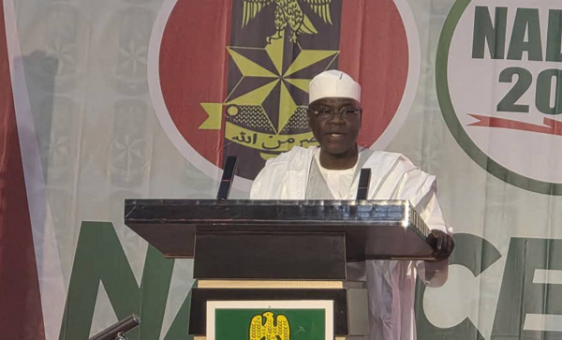
Former Chief of Army Staff and Zarumman Sokoto, Lieutenant General Faruk Yahaya, has cautioned that without prioritising the welfare of troops engaged in the fight against terrorism and other criminal activities nationwide, soldiers may be deprived of the motivation needed to perform effectively on the frontlines.....KINDLY READ THE FULL STORY HERE▶
Prioritise Soldiers’ Welfare or Risk Undermining the Fight Against Terrorism — Ex-Army Chief Warns
Former Chief of Army Staff and Zarumman Sokoto, Lieutenant General Faruk Yahaya (rtd), has issued a stark warning that the morale and effectiveness of Nigerian soldiers in the fight against terrorism and criminality will remain threatened unless their welfare is made a national priority.
Yahaya delivered the warning on Friday while speaking at the Nigerian Defence Academy (NDA) Auditorium in Kaduna as the guest lecturer at the 2025 Nigerian Army Day Celebration (NADCEL), marking the Army’s 162nd anniversary.
In his lecture, titled “The Soldier First Concept and the Future of the Nigerian Army: Shaping a New Culture for Army Transformation,” Yahaya stressed that proper motivation, especially through improved welfare, is foundational to operational success and troop resilience.
He identified three critical areas requiring urgent government intervention to uplift soldiers’ morale and capabilities: adequate housing, quality education for their children, and comprehensive healthcare services.
“One of the biggest welfare crises facing the Nigerian Army today is inadequate accommodation for personnel, particularly soldiers,” he stated. “The Army had to rapidly expand its manpower in response to the rising threats of insurgency, terrorism, and insecurity over the years. Unfortunately, this expansion was not matched with a proportional increase in housing.”
He lamented that many soldiers are now forced to live among civilians in suburban areas, with some barracks so overcrowded that multiple families share a single living space. “The consequences of such living conditions are better imagined,” he added, calling for a targeted Federal Government intervention to address the housing deficit.
On education, Yahaya noted that although successive Army leaderships established various welfare schools—such as Army Children Schools, Command Secondary Schools, and the Nigerian Military School—the quality of these institutions has declined over time.
“This has pushed many soldiers to enrol their children in private schools, often stretching their limited incomes. It’s a silent morale killer,” he warned, urging reforms to restore excellence in Army-run schools in honour of the sacrifices made by military families.
Turning to healthcare, the former Army chief acknowledged progress in the military medical system but said more investment was needed. He proposed the establishment of dedicated rehabilitation centres to cater to long-term patients currently occupying tertiary hospital beds and advocated for a special recruitment drive to close personnel gaps in specialist medical care.
Earlier, the current Chief of Army Staff, Lieutenant General Olatunbosun Oluyede, reiterated the Army’s commitment to the “Soldier First” philosophy, aimed at transforming the force by prioritising welfare, training, and operational readiness.
“This concept considers the evolving nature of warfare, generational expectations, and the centrality of the individual soldier in modern military operations,” Oluyede said. “It means putting the training, equipping, and proper administration of our troops at the forefront, while also demanding their loyalty to the core values of the Nigerian Army.”
The 2025 NADCEL events continue across various formations nationwide, reflecting on the Army’s legacy, challenges, and its evolving role in safeguarding Nigeria’s sovereignty.







Comments
0 comments